Fire Pump Reliability Australia Selection Guide
A practical guide to choosing, designing, and maintaining fire pumps in facilities that cannot afford a single misstep.
I have spent enough time around pump rooms to know one thing for sure. When everything else goes quiet, the fire pump is the one piece of equipment that must wake up without hesitation. In Australia, where regulations are firm and expectations even firmer, fire pump reliability Australia is not a luxury. It is the backbone of protection for commercial towers, industrial plants, and large scale facilities that cannot afford a single misstep.
So, let me walk you through how I approach fire pump selection when reliability is not just important, but absolutely non negotiable.
Understanding fire pump reliability Australia in high risk facilities
First, I ground every decision in context. Not all buildings carry the same risk. A hospital, data center, or high rise commercial complex demands a level of reliability that borders on obsessive. And rightly so.
Because when a fire event occurs, there is no warm up lap. The pump either performs instantly, or it fails the entire system.
Therefore, I focus on three pillars. Redundancy, compliance, and endurance. Australian standards such as AS 2941 set the baseline, but in high reliability environments, I go beyond minimum compliance. I treat those standards as the starting line, not the finish.
Besides, no one ever praised a system for doing the bare minimum. That is like applauding a smoke detector for having batteries. Expected, not impressive.
The three reliability pillars
- Redundancy that keeps water flowing when components fail
- Compliance that aligns with AS 2941 and AS 2419
- Endurance for long duration fire scenarios and harsh environments
Where fire pump reliability Australia must be absolute
- Hospitals and healthcare facilities
- Data centers and critical IT infrastructure
- High rise commercial and residential towers
- Industrial plants and hazardous storage sites
How do I choose the right fire pump for continuous performance
Start with the driver
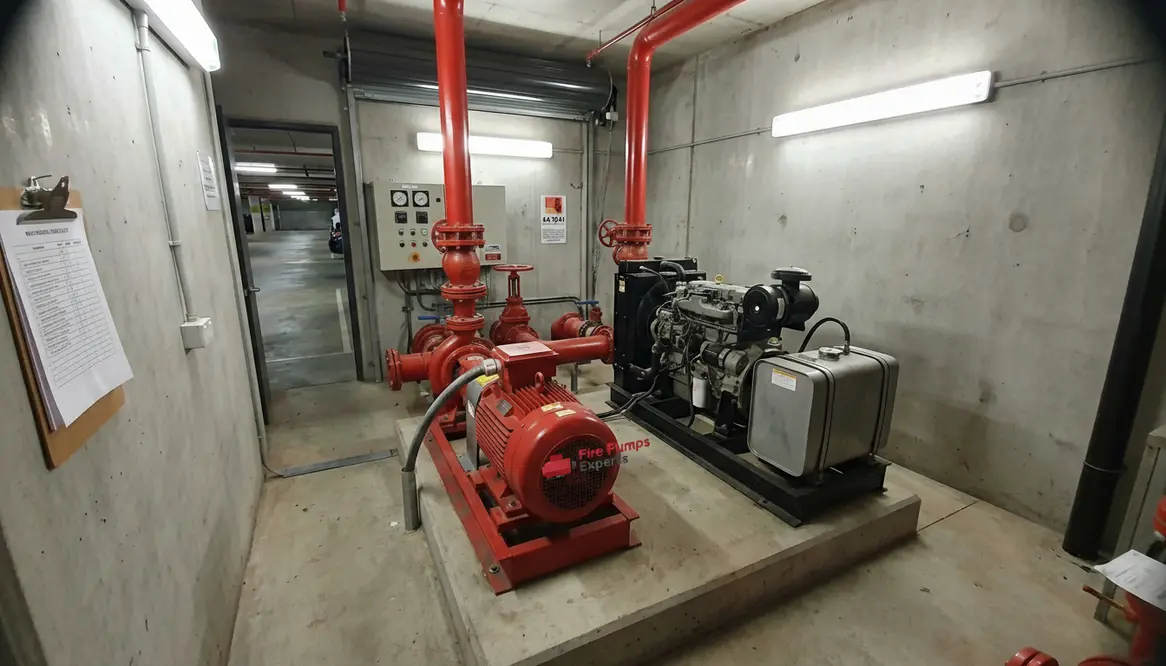
I start with the driver type. Electric pumps are efficient and clean, however diesel pumps bring independence from grid failure. In critical facilities, I often specify both. Yes, it costs more upfront, but downtime costs far more.
When fire pump reliability Australia is on the line, dual drivers turn a single point of failure into a managed risk.
Match configuration to the environment
Next, I look at pump configuration. Split case pumps dominate in large commercial systems because they offer durability and easier maintenance. Vertical turbine pumps step in when water sources demand it. Each has its place, and I match the pump to the environment, not the other way around.
Sizing for performance, not ego
Then comes sizing. Oversizing might sound safe, but it creates inefficiency and stress on the system. Undersizing is worse. So, I rely on detailed hydraulic calculations, ensuring the pump meets peak demand without strain.
See the whole orchestra
And importantly, I always consider the full system. A pump is only as reliable as the network it feeds. Pipes, valves, and controllers must all work in harmony. Think of it as an orchestra. One out of tune instrument ruins the entire performance.
Key design features that strengthen system reliability
Now, this is where things get interesting. Because reliability is not just about choosing a good pump. It is about designing a system that refuses to fail.
Here is how I approach it.
Left column
- Redundant pump sets that activate automatically
- Independent power supplies for each driver
- Advanced controllers with fault detection
- Regular testing systems built into the design
Right column
- High quality materials that resist corrosion
- Accessible layouts for maintenance teams
- Pressure relief systems to prevent overload
- Remote monitoring for real time performance tracking
Furthermore, I design for human error. Because even the best technicians have off days. Clear layouts, intuitive controls, and automated alerts reduce the chance of mistakes. And in this field, reducing mistakes is everything.
Fire pump reliability Australia and compliance with local standards
In Australia, compliance is not optional, and frankly, that is a good thing. Standards like AS 2941 and AS 2419 exist because failures have consequences.
However, I never treat compliance as a checklist exercise. Instead, I integrate it into the design philosophy. For example, I ensure test facilities are not just present, but easy to use. Because if testing is difficult, it gets skipped. And skipped tests lead to surprises. The bad kind.
Additionally, I coordinate closely with fire engineers, certifiers, and facility managers. That collaboration ensures the system meets both regulatory requirements and real world demands.
After all, a perfectly compliant system that struggles under actual conditions is about as useful as a superhero who only works office hours.
For deeper technical references and resources, I often cross check guidance on sites like https://firepumps.org/ alongside Australian standards to align global best practice with local rules.
Maintenance planning starts at the selection stage
Here is a truth many overlook. Reliability is not installed. It is maintained.
So, when I select a fire pump, I think about the next ten years, not just the day it is commissioned. I ask simple questions. Can technicians access components easily. Are spare parts readily available in Australia. Is the system designed for straightforward testing.
Designing for easy upkeep
- Clear access to strainers, valves, and controllers
- Logical pipework that allows safe isolation for maintenance
- Documented test procedures that teams can follow without guesswork
Using data to protect uptime
Moreover, I favor systems with predictive maintenance capabilities. Sensors that monitor vibration, temperature, and pressure give early warnings. And early warnings mean controlled fixes, not emergency repairs.
Because no facility manager wants a midnight call that starts with the words something is not right.
Handled properly, maintenance becomes the quiet partner that keeps fire pump reliability Australia exactly where it needs to be.
FAQ about fire pump selection and reliability
Final thoughts on building a system that never hesitates
When I select a fire pump system, I am not just choosing equipment. I am building confidence into a facility. Every decision, from driver type to maintenance access, shapes how that system performs when it matters most.
If you are planning or upgrading a system, take reliability seriously from day one. Work with experts who understand high demand environments and Australian standards inside out. Because when the moment comes, hesitation is not an option. And the right fire pump system ensures your facility stands ready, calm and prepared, no matter what unfolds. That is the standard fire pump reliability Australia should always be measured against.