Fire Pump Requirements for Banquet Halls Guide
I have walked through enough event halls to know one thing for certain. When the lights dim and the music rises, no one is thinking about fire safety. And yet, it is the quiet systems behind the walls that matter most. That is where Fire Pump Requirements for Banquet Halls come into play. Within the first moments of an emergency, these systems decide whether a situation stays controlled or turns into chaos. So, while guests focus on the buffet, I focus on flow rates, pressure, and reliability. It is not glamorous. But it is essential.
What fire safety systems do large dining venues actually need
Let me answer this the way most people wish building codes were explained. Simply and without the headache.
Large assembly dining spaces demand layered protection. First, you need automatic sprinkler systems that cover every inch of the occupied space. Next, you need standpipes for firefighter access. However, none of that works without consistent water pressure. That is where fire pump systems step in.
In high occupancy venues, water supply from municipal lines often falls short. Therefore, a dedicated pump ensures that pressure remains steady even during peak demand. Think of it as the difference between a garden hose and a fire hose. Same water. Very different outcome.
Additionally, detection systems must connect seamlessly with alarms and emergency lighting. Because when visibility drops, even the most elegant ballroom turns into a maze from a horror movie. And nobody wants to star in that.
Why pressure and flow quietly run the show
Sprinklers are only as good as the water feeding them. In many banquet halls, particularly in taller or sprawling buildings, municipal water alone cannot guarantee the flow and pressure needed during a serious fire. Fire Pump Requirements for Banquet Halls exist precisely to close that gap, so the promise made on paper matches performance in the worst possible moment.
Think of it this way: the décor sells the venue, but the pump system protects it. Guests might notice chandeliers first, but if sprinklers sputter instead of spray, the story ends badly for everyone involved.
Fire Pump Requirements for Banquet Halls and high occupancy venues
I like to think of fire pumps as the quiet bodyguards of a building. They do not show off. But when things go wrong, they step in fast.
For banquet halls and large dining facilities, fire pump requirements focus on reliability, capacity, and redundancy. First, the pump must meet the hydraulic demand of the sprinkler system. That includes peak flow during worst case scenarios. Second, backup power is not optional. If the main power fails, the pump must keep running without hesitation.
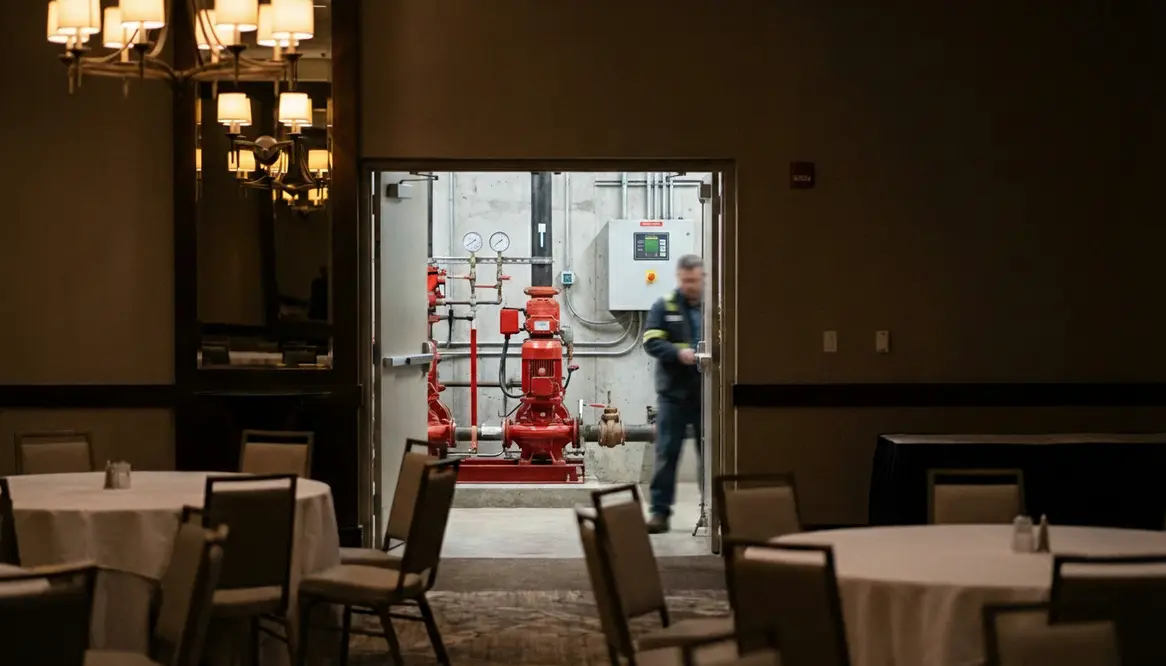
Moreover, installation location matters. Pumps should sit in protected, accessible rooms designed to withstand fire exposure. Because placing critical equipment in a vulnerable area defeats the entire purpose.
Regular testing also plays a role. Weekly churn tests and annual flow tests ensure that the system performs when needed. Skipping these checks is like owning a sports car and never turning the key. It looks impressive. It just does not do anything useful.
Key performance expectations
- Deliver required pressure to the most remote sprinkler or hose connection
- Start automatically on pressure drop or system demand
- Operate on reliable primary and secondary power sources
- Stay accessible for service without shutting down the entire venue
Designing safer assembly dining spaces from the ground up
When I look at a well designed venue, I see more than décor. I see intentional planning.
First, layout matters. Wide, clearly marked exits reduce congestion during evacuations. Additionally, spacing between tables should allow for smooth movement, even when the room is full. Because in an emergency, seconds matter more than centerpieces.
Second, materials play a huge role. Fire resistant finishes, furnishings, and wall coverings slow down flame spread. This buys valuable time for evacuation and suppression systems to do their job.
Then there is ventilation. Kitchens connected to dining areas require proper hood suppression systems. Without them, a small grease fire can escalate quickly. And trust me, no one wants their event trending online for the wrong reason.
Where pumps fit into the bigger safety picture
Even the best evacuation routes and finishes will not overcome a weak water supply. Fire Pump Requirements for Banquet Halls connect directly to building layout, kitchen design, and occupancy strategies. When storage rooms, stages, or partitioned ballrooms change, hydraulic demand can change too, and that is when pump capacity and settings deserve another look.
Left Column Key risks I watch for / Right Column Smart prevention strategies
Key risks I watch for
Overcrowding
Limit occupancy and enforce it strictly.
Blocked exits
Keep pathways clear at all times.
Insufficient water pressure
Install and maintain compliant fire pump systems.
Kitchen hazards
Use certified suppression systems and train staff.
Poor maintenance
Schedule routine inspections and testing.
Smart prevention strategies
Post occupancy limits where staff can actually see them and treat them as non negotiable, even when one more table wants to squeeze in for a big night.
Train staff to spot blocked exits the way managers spot empty tables: immediately and with zero tolerance.
Tie routine pump testing into a recurring calendar, and log results so you can prove that Fire Pump Requirements for Banquet Halls are not just a phrase on a plan review, but a living part of operations.
For kitchens, pair equipment upgrades with real-world drills: staff should know exactly what to do when a pan flares or a hood trips.
Create a maintenance culture where worn valves, damaged sprinklers, or noisy pumps get attention now, not after the next busy season.
How do I maintain fire safety without disrupting operations
This is the question I hear most often. And honestly, it is a fair one.
First, schedule inspections during off hours. Early mornings or closed days work best. That way, testing does not interfere with events. Additionally, staff training should be ongoing but efficient. Short, focused sessions tend to stick better than long lectures.
Technology also helps. Modern monitoring systems provide real time alerts for pressure drops or faults. So instead of waiting for a problem, you catch it early.
And yes, documentation matters. Keeping clear records of inspections, tests, and repairs ensures compliance and builds trust with inspectors. It also saves time when audits come around. Because nothing ruins a good day like scrambling for paperwork five minutes before an inspection.
Turning requirements into a routine
Fire Pump Requirements for Banquet Halls fit more smoothly into daily life when they are built into checklists and recurring tasks instead of last-minute emergencies. Assign clear responsibility for weekly pump runs, alarm checks, kitchen hood inspections, and egress walkthroughs, then keep those responsibilities stable so knowledge deepens over time.
Fire Pump Requirements for Banquet Halls in real world applications
Let us bring this down from theory to reality.
In large commercial venues, fire pump systems often include both electric and diesel driven units. This dual setup ensures operation under different conditions. Furthermore, controllers must meet strict standards for automatic activation.
Flow demand calculations are not guesswork. Engineers base them on building size, occupancy load, and hazard classification. Therefore, each system is tailored to the property rather than copied from a template.
Another critical factor is integration. Fire pumps must work seamlessly with alarms, sprinklers, and building management systems. When everything communicates properly, response times improve dramatically.
And here is a small truth. The best systems are the ones no guest ever notices. Like good lighting in a movie, it does its job without stealing the spotlight.
For more technical breakdowns and reference material on commercial fire pumps and system performance, resources such as https://firepumps.org can be useful starting points alongside local codes and standards.
FAQ
Conclusion
Fire safety in event and assembly dining spaces is not just a requirement. It is a responsibility. From proper design to meeting Fire Pump Requirements for Banquet Halls, every detail matters. If you manage or develop large commercial venues, now is the time to act. Review your systems, schedule inspections, and partner with experts who understand high demand environments. Because when safety works as it should, no one notices. And that is exactly the point.