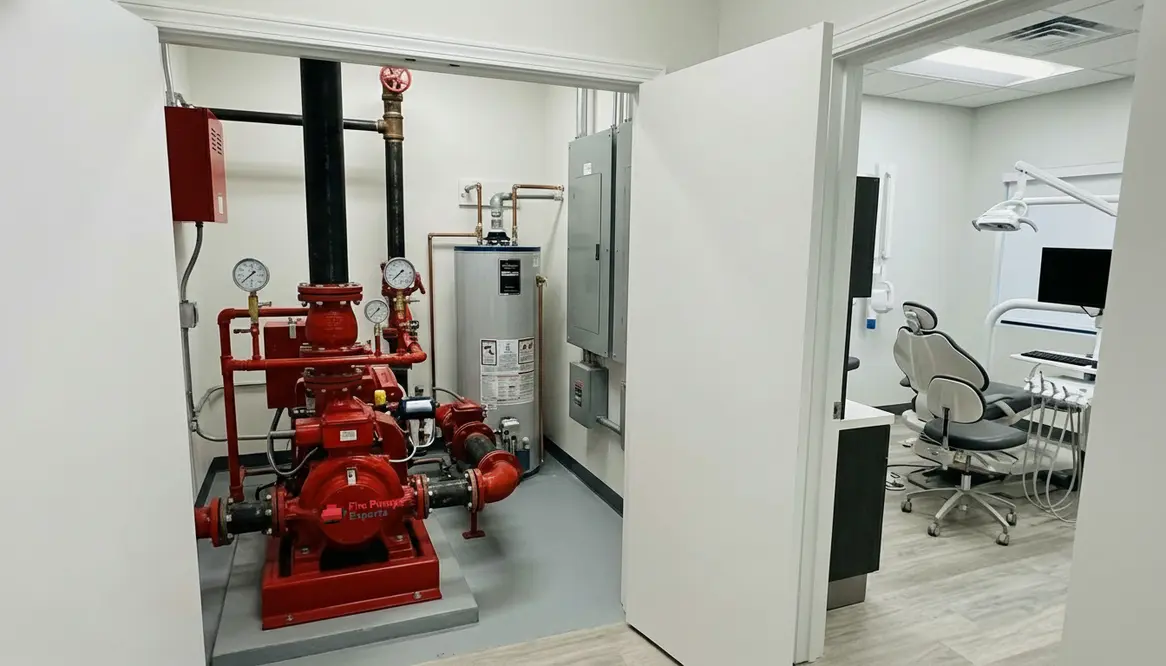
Fire Pump Systems for Dental Offices Guide
A practical look at how quiet, reliable protection turns small dental clinics into well-defended spaces when it matters most.
I have spent enough time walking the halls of healthcare buildings to know one thing for certain. Safety rarely announces itself. It hums quietly behind walls, inside pipes, and beneath floors. And when we talk about Fire Pump Systems for Dental Offices, we are really talking about that silent promise. The promise that when things go wrong, the system does not. Smaller healthcare spaces may seem simple on the surface, but fire protection in these environments carries weight. After all, even a modest clinic deserves a response worthy of a blockbuster rescue scene, just without the dramatic soundtrack.
This guide focuses on how Fire Pump Systems for Dental Offices can be right-sized, code-aligned, and quietly dependable without turning a small clinic into a mechanical jungle.
Why Smaller Healthcare Facilities Still Need Serious Fire Protection
At first glance, a small dental clinic or outpatient space does not feel like a high risk environment. However, that assumption can lead people down the wrong path. These spaces often contain electrical equipment, compressed gases, and flammable materials tucked neatly out of sight. Because of that, the fire risk is not about size. It is about function.
Moreover, local codes and national standards often require fire suppression systems regardless of square footage. When water pressure from the municipal supply falls short, a fire pump steps in like a reliable understudy who knows every line. Without it, sprinkler systems may not perform as designed.
So while the building may be small, the expectations for safety remain large. And rightly so.
When Do Fire Pump Systems for Dental Offices Become Necessary
I get this question often, usually with a hopeful tone, as if the answer might be never. But let me be clear. There are specific scenarios where a fire pump becomes essential.
If the incoming water supply cannot meet pressure or flow demands, a pump is required. Additionally, multi story medical office buildings, even modest ones, often trigger this need due to elevation changes. Furthermore, when a facility expands or renovates, the existing system may no longer meet updated code requirements.
Think of it like upgrading from a garden hose to a fire hose. Both move water. Only one can handle the job when it really matters.
What Makes Healthcare Spaces Different From Typical Commercial Buildings
Healthcare environments operate with a different rhythm. Patients may have limited mobility. Staff focus on care, not evacuation logistics. Because of this, fire protection systems must act faster and more reliably.
In addition, dental and medical spaces often include specialized rooms with unique hazards. Sterilization areas, imaging equipment, and storage for medical gases all influence system design. Therefore, fire pump solutions must align with these operational realities rather than follow a generic template.
It is a bit like tailoring a suit. Off the rack might look fine, but a custom fit moves better and performs when it counts.
Key Components That Keep Fire Pump Systems Reliable
When I evaluate a system, I focus on how each component supports the whole. A fire pump is not just a piece of equipment. It is part of a coordinated response.
Core Elements
- Pump unit sized for demand
- Controller with automatic start
- Reliable power source
- Pressure sensing devices
Support Systems
- Water storage or supply connection
- Backflow prevention
- Routine testing setup
- Monitoring and alarms
Each part plays a role. If one fails, the entire system weakens. That is why design and maintenance matter just as much as installation.
How I Approach Fire Pump Systems for Dental Offices Without Overbuilding
Now here is where things get interesting. It is easy to overspend on systems that exceed actual needs. On the other hand, cutting corners invites risk. The balance lies in precision.
I start with flow and pressure requirements based on code and building layout. Then, I evaluate the existing water supply. If it meets demand, great. If not, we introduce a pump sized exactly for the gap. Not more, not less.
Additionally, I consider long term operation. Smaller healthcare facilities often lack on site engineering staff. Therefore, systems must be straightforward to maintain. No one wants a setup that feels like it belongs in a sci fi movie where only one person knows how to turn it on.
In short, the goal is efficiency without compromise.
Can Small Clinics Rely on City Water Alone
Sometimes they can. Often they cannot.
Municipal water systems vary widely. In some areas, pressure fluctuates throughout the day. In others, infrastructure limits available flow. Because fire protection systems require consistent performance, relying solely on city water can introduce uncertainty.
That is where a fire pump adds confidence. It ensures the system delivers the required pressure regardless of outside conditions. And when you are dealing with patient safety, confidence is not a luxury. It is a requirement.
Where Fire Pump Systems for Dental Offices Fit Into the Bigger Picture
Fire Pump Systems for Dental Offices do not operate in isolation. They interact with sprinklers, alarms, emergency procedures, and building operations. A well-planned installation looks beyond hardware and considers how people will actually move, respond, and protect patients during a real event.
That is why coordination with designers, facility leaders, and local authorities is so important. The best systems feel almost invisible on a normal day and absolutely unstoppable on the worst day.
FAQ
Conclusion
When I look at smaller healthcare spaces, I do not see limitations. I see precision. The right fire protection system, built with purpose, ensures safety without excess. If your facility depends on consistent performance, it is time to evaluate whether a fire pump belongs in your design. Work with people who understand commercial and industrial demands, and let Fire Pump Systems for Dental Offices be designed to work quietly, reliably, and exactly when they are needed.