Hospital Fire Pump Requirements in New Jersey
I have spent enough time walking through mechanical rooms to know this truth: if a building has a heartbeat, the fire pump room is it. And when we talk about hospital fire pump requirements, we are really talking about the highest standard of reliability that commercial and industrial property owners in New Jersey should pay attention to. After all, if a system is trusted to protect lives in a hospital, it sets the tone for what your property should aim for. So let’s slow this down, take a clear look, and make sense of what really matters.
What are fire pump room requirements in New Jersey for commercial buildings?
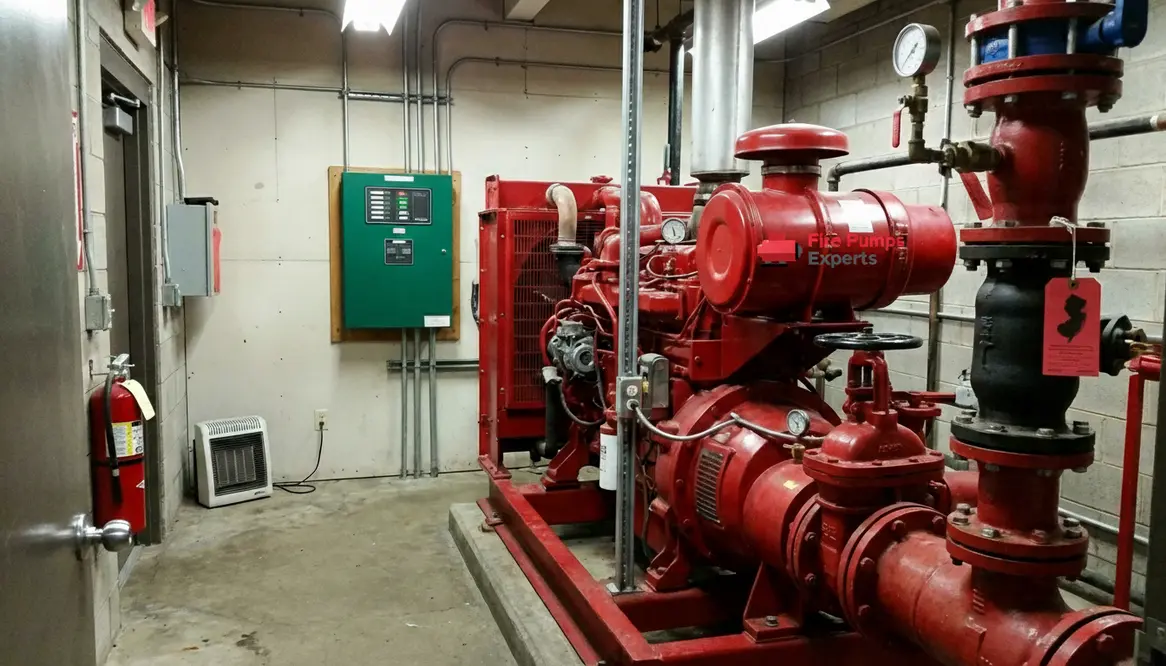
In New Jersey, fire pump rooms are not an afterthought. They are regulated spaces designed to ensure your suppression system performs under pressure. Literally. The state follows NFPA standards, and local codes often add their own flavor, much like a Jersey diner adding extra fries when you did not ask.
First, the room must be dedicated. That means no storage, no seasonal decorations, and definitely no forgotten office chairs. Additionally, it needs proper fire rated construction, typically two hours, to protect the equipment from external fire exposure.
Then there is access. You need direct access from the exterior or through a protected corridor. Firefighters should not have to play hide and seek during an emergency.
Temperature control also matters. Fire pumps do not enjoy freezing conditions. Therefore, heating systems must keep the room above minimum thresholds, typically around 40 degrees Fahrenheit.
Finally, ventilation, drainage, and lighting must all support continuous operation. Because when a fire pump runs, it is not taking breaks.
Connecting New Jersey codes and higher-risk facilities
Even when you are not designing a hospital, looking at hospital fire pump requirements gives you a roadmap. If the most demanding occupancies can keep pumps accessible, protected, and powered during chaos, there is no reason your distribution center, office tower, or manufacturing plant should settle for less.
Why hospital fire pump requirements set the gold standard
Now, let’s circle back to hospital fire pump requirements. These systems are built with redundancy, reliability, and zero tolerance for failure. And while your commercial high rise or industrial facility may not house patients, the expectation for performance should feel just as serious.
For example, hospitals often require backup power integration that kicks in instantly. Similarly, controllers are monitored and alarmed to detect even minor faults. This level of oversight is something I often recommend for large scale properties.
Redundancy and monitoring
Moreover, hospitals emphasize separation of hazards. That means fuel sources, electrical systems, and pump components are arranged to avoid a single point of failure. It is a bit like not putting all your eggs in one basket, except the basket is on fire, and the eggs are your building.
Setting your own benchmark
So, while the code may not demand hospital level systems for every facility, aiming in that direction reduces risk and increases long term reliability. Treat hospital fire pump requirements as the benchmark you measure against, not the distant ideal you admire from across the street.
How should a fire pump room be designed for long term performance?
I like to think of design as the difference between a system that survives inspections and one that performs when it matters. Because those are not always the same thing.
First, spacing is critical. You need enough clearance around the pump, controller, and valves to allow maintenance. If a technician has to twist like a movie action hero just to reach a valve, something went wrong in design.
Next, consider water supply reliability. Whether it is a municipal feed, a storage tank, or a combination, the system must maintain consistent pressure and flow. In New Jersey, where infrastructure can vary by region, this becomes especially important.
Also, noise and vibration control should not be ignored. Fire pumps are not subtle machines. Without proper mounting and isolation, they can turn your building into an unexpected percussion instrument.
Key design elements
- Dedicated fire rated room construction
- Adequate clearance for service access
- Reliable heating and ventilation systems
- Proper drainage to handle overflow
Operational priorities
- Consistent water supply and pressure
- Backup power integration
- Accessible layout for emergency crews
- Monitoring and alarm systems
If you want a deeper technical breakdown of performance, maintenance, and testing approaches beyond the basics of hospital fire pump requirements, a solid next step is reviewing a guide like fire pump servicing best practices from a specialized fire pump service provider.
Common compliance mistakes I see across New Jersey properties
Even well managed facilities can miss the mark. And yes, I have seen things that would make a fire inspector sigh like a tired sitcom dad.
Misusing the fire pump room
One frequent issue is improper use of the pump room. It slowly becomes a storage area. Then suddenly, access is blocked, and inspections fail.
Letting maintenance slide
Another problem is neglected maintenance. A fire pump is not a decorative piece. नियमित testing, including weekly churn tests and annual flow tests, ensures the system works when needed.
Weak power and aging gear
Additionally, power supply gaps often appear. Some buildings lack reliable backup power, which defeats the purpose of the system during outages.
Lastly, outdated components can quietly undermine performance. Controllers, valves, and sensors age over time. Without upgrades, you are relying on yesterday’s technology to solve today’s emergencies.
How do I keep my fire pump room compliant and inspection ready?
Staying compliant is less about scrambling before inspections and more about building consistent habits.
Routine checks and testing
Start with routine inspections. Weekly visual checks help catch issues early. Then, schedule professional testing and servicing at required intervals.
Documentation and training
Documentation is your best friend. Keep records of all tests, repairs, and upgrades. Inspectors appreciate it, and it protects you legally.
Also, train your staff. Even basic awareness can prevent accidental misuse of the space. Because the only thing worse than a failed system is a preventable failure.
Leaning on local expertise
Finally, partner with specialists who understand commercial and industrial systems in New Jersey. Local expertise matters. Codes evolve, and having someone who keeps up saves you from surprises. The higher bar set by hospital fire pump requirements becomes a lot more achievable when you have a team whose full-time job is staying current on NFPA and local amendments.
FAQ
A few quick answers to common questions that come up when people start comparing their own systems to hospital fire pump requirements and New Jersey code expectations.
Keep your system ready before it is needed
In my experience, the best fire pump rooms are the ones no one thinks about until they work perfectly. That does not happen by accident. It takes planning, maintenance, and a commitment to higher standards, often inspired by models like hospital systems.
If your commercial or industrial property needs guidance, testing, or upgrades, now is the time to act. Because when the moment comes, your system should not hesitate. And neither should you.