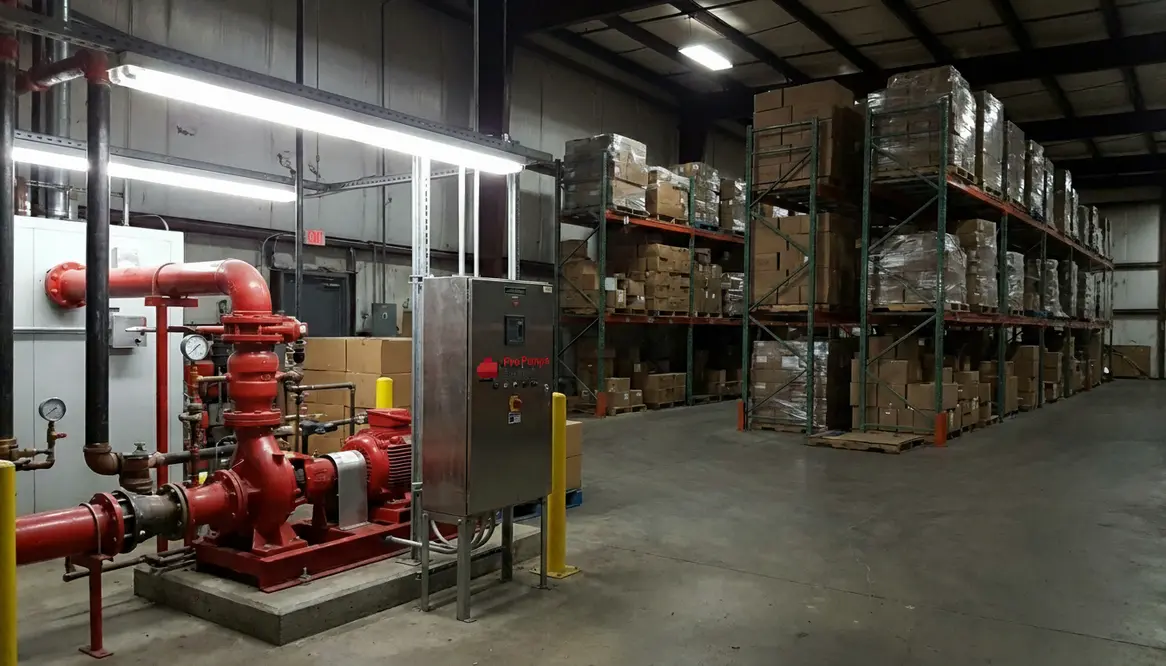
How Storage Type Impacts Fire Pump Planning
I have spent years around industrial facilities where the quiet hum of machinery hides a simple truth. Fire does not negotiate. It moves fast, and it demands respect. That is why How storage type changes fire pump planning is not just a design note. It is the foundation of a reliable fire protection strategy. From towering rack systems to tightly packed bulk storage, every configuration shifts the way a fire pump must perform. And yes, if you ignore that detail, the fire will not politely remind you. It will make its point the loud way.
Why fire pump systems matter in large storage environments
When I walk into an industrial storage building, I do not just see shelves and pallets. I see fuel loads, airflow paths, and risk stacking up like a suspense movie waiting for its third act. Fire pump systems act as the heartbeat of suppression. Without them, sprinklers are just expensive ceiling decorations.
Because storage facilities often exceed municipal water capacity, fire pumps step in to deliver the pressure and flow needed to control a fire early. In addition, they ensure consistency. City supply can fluctuate. A properly designed pump system does not.
And let’s be honest, depending on luck in fire protection is like trusting a horror movie character who says, “I will be right back.” It rarely ends well.
How storage type changes fire pump planning
Different storage, different fire behavior
Different storage types demand different strategies. High piled storage creates vertical fire spread, which increases pressure requirements. On the other hand, flammable liquids demand rapid, high density water application.
From commodities to layout
I always adjust pump sizing based on commodity classification, storage height, and aisle configuration. For example, rack storage often requires higher flow rates due to fire plume development between shelves. Meanwhile, solid pile storage behaves differently, often concentrating heat and requiring faster suppression response.
Therefore, the phrase How storage type changes fire pump planning becomes practical. It affects pump capacity, redundancy, and even power supply decisions. One size does not fit all. Not in shoes, and definitely not in fire protection.
What factors influence fire pump selection for industrial buildings?
Hazard, scale, and growth
I look at several factors immediately. First, hazard classification. This tells me how aggressive the system needs to be. Next, building size and layout. Larger footprints often require zoned approaches or higher capacity pumps.
Then there is water supply reliability. If municipal pressure drops, the pump must compensate without hesitation. In addition, I consider future expansion. Because no facility stays frozen in time, the system should allow for growth without complete redesign.
Power and resilience
Power source also matters. Electric pumps offer efficiency, while diesel pumps provide reliability during outages. Choosing between them is not about preference. It is about risk tolerance and operational continuity.
Inside the system: components that do the heavy lifting
Core Components
- Fire pump unit
- Controller system
- Jockey pump
- Water supply connection
- Relief valves
What they actually do
- Delivers required pressure and flow
- Starts and monitors pump operation
- Maintains system pressure during idle periods
- Feeds water from tank or city supply
- Prevents system overpressure
Each component plays a specific role. Together, they create a system that reacts instantly. Because in a fire event, hesitation is not part of the plan.
Designing for performance, not just compliance
Beyond the minimums
I have seen systems that technically meet code but struggle under real world conditions. Compliance is the baseline. Performance is the goal.
To achieve that, I run hydraulic calculations that reflect actual storage layouts, not theoretical ones. I also factor in friction loss, elevation changes, and simultaneous system demand. In addition, I consider worst case scenarios. Because fires do not follow best case assumptions.
Furthermore, I prioritize system testing and commissioning. A fire pump that looks good on paper but fails during testing is like a gym membership you never use. It exists, but it does not help when it matters.
How storage type changes fire pump planning
Commodity risks and special environments
Let’s go deeper. Commodity type changes everything. Plastics, for example, burn hotter and faster than ordinary goods. That requires higher discharge pressure and increased flow duration.
Cold storage facilities introduce another twist. Low temperatures can affect water delivery and system responsiveness. So, I adapt pump design to ensure consistent operation even in challenging environments.
Automation, airflow, and coordination
Additionally, automated storage systems create unique airflow patterns. These can accelerate fire spread in unexpected ways. Therefore, pump performance must align with suppression system design to maintain control.
In short, adapting fire pump planning to storage conditions is not optional. It is essential. Fire does not care how organized your inventory is. The reality of How storage type changes fire pump planning is that each decision on shelving, stacking, and commodities silently rewrites the rules your pump has to follow.
Maintenance keeps the system honest
A fire pump system is not something I install and forget. Regular testing ensures it performs when needed. Weekly churn tests, annual flow tests, and controller checks all play a role.
Moreover, I encourage facility managers to treat maintenance like insurance. You hope you never need it, but you definitely want it working when you do.
And yes, skipping maintenance to save money is like ignoring a check engine light. It might be fine. Or it might be a very expensive surprise. The same logic that governs How storage type changes fire pump planning should also govern how you plan inspections: align effort with risk, not convenience.
FAQ: Fire pump systems for industrial storage buildings
Conclusion
If you manage or design an industrial storage facility, now is the time to take a closer look at your fire pump system. I can help you align performance with real world risk, not just minimum standards. Reach out to https://firepumps.org and let’s build a system that works when it matters most. Because when fire shows up, preparation should already be in place, steady and ready. The real payoff of understanding How storage type changes fire pump planning is simple: when your inventory configuration changes, you will know how to keep your protection strategy one step ahead.