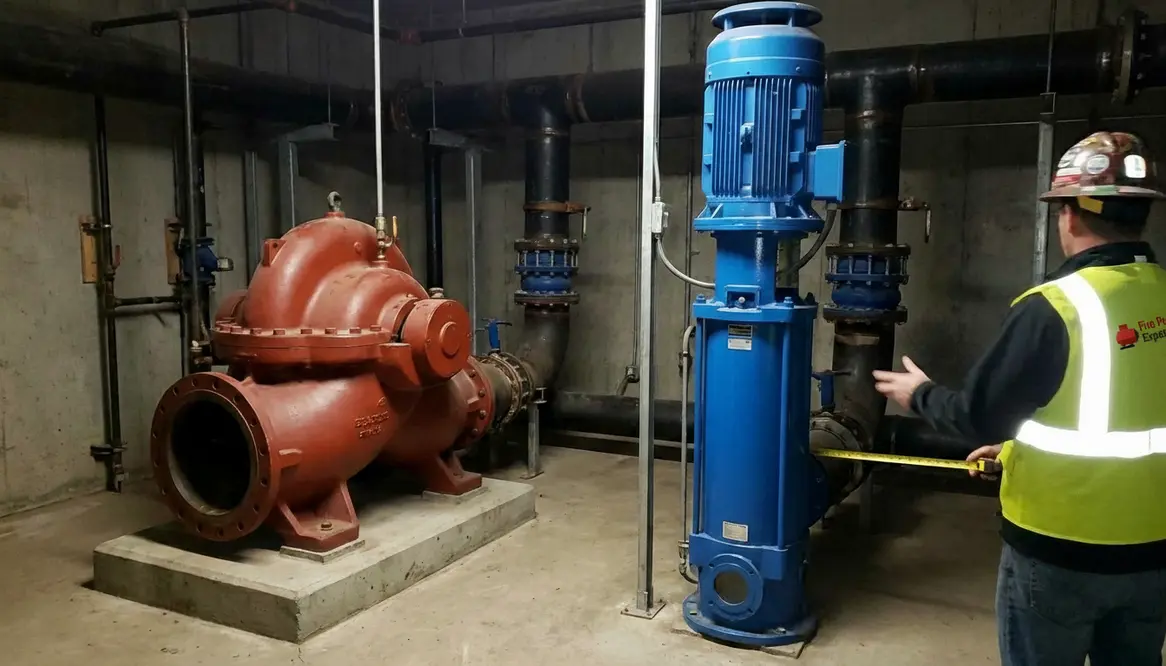
Split Case Pump vs Vertical Turbine Pump Guide
I have spent enough time around pump rooms to know one thing for sure. Not all pumps are built for the same story. When people ask me about split case pump vs vertical turbine pump, I picture two very different characters walking into the same mechanical room. One is wide, grounded, and steady. The other is tall, precise, and built to reach deep. Both get the job done, but they do it in ways that can make or break a commercial or industrial system.
So let me walk you through it. Slowly. Clearly. And with just enough humor to keep us both awake.
Understanding the Role of Pumps in Commercial Fire Protection
First, let us set the stage. In large facilities, fire pumps are not optional. They are the quiet guardians waiting for the worst day. And when that day comes, they must perform without hesitation.
Now, choosing between pump types is not just a technical decision. It affects reliability, maintenance access, and even building design. Therefore, when I compare systems like a horizontal split case pump and a vertical turbine pump, I look beyond shape. I look at how they behave under pressure, literally and figuratively.
In fact, if you want a broader view of how these systems integrate into fire protection strategies, I often point people toward commercial fire pump system guidance found on trusted industry resources like firepumps.org. It gives context that matters.
Split Case Pump vs Vertical Turbine Pump: What Is the Core Difference?
At the heart of it, the difference comes down to orientation and water source.
A horizontal split case pump sits low and wide. It pulls water from a reliable, flooded source like a tank or municipal supply. Because of its design, I can open it like a book for maintenance. No gymnastics required.
On the other hand, a vertical turbine pump works when water sits deep below grade. Think wells or underground reservoirs. It uses a long vertical shaft to bring water up. It is elegant in its own way, like a skyscraper compared to a ranch house.
However, the choice is not about which looks cooler in a blueprint. It is about matching the pump to the site conditions. That is the real core of the split case pump vs vertical turbine pump decision.
When Should I Choose a Horizontal Split Case Pump?
I lean toward horizontal split case pumps when the water supply is stable and accessible. They shine in facilities where reliability and ease of maintenance matter most.
For example, in large commercial buildings or industrial plants with dedicated water storage, these pumps offer consistent performance. In addition, they handle high flow rates with impressive efficiency.
Here is what I appreciate most:
- Ease of maintenance because I can access internal components without disconnecting piping
- Long service life when properly maintained
- Stable performance under continuous demand
That said, they do take up more floor space. So if your pump room already feels like a packed subway car at rush hour, this might not be your first pick in the split case pump vs vertical turbine pump conversation.
Vertical Turbine Pumps in Deep Water Applications
Now, when water is not readily available at the surface, I turn to vertical turbine pumps. These systems are designed to reach down and pull water up efficiently.
They are common in industrial sites where underground water sources are the only option. And while they require more specialized installation, they solve a problem that horizontal pumps simply cannot.
What stands out to me:
- Ability to access deep water sources without additional infrastructure
- Space saving design since most components sit vertically
- Adaptability for varying water levels
However, maintenance can be more involved. You are not just opening a casing. You are dealing with long shafts and submerged components. It is less “pop the hood” and more “prepare for a careful disassembly.” That is a key nuance when weighing split case pump vs vertical turbine pump options.
Side by Side Comparison for Quick Decision Making
Sometimes, we all need a simple visual. So here is how I mentally break down the split case pump vs vertical turbine pump conversation:
Horizontal Split Case Pump
- Reliable surface water supply
- Easy maintenance access
- Requires more horizontal space
- Ideal for large commercial facilities
Vertical Turbine Pump
- Designed for deep water sources
- More complex maintenance
- Compact footprint above ground
- Best for industrial sites with wells or pits
It is not a battle of better or worse. It is about fit. Like choosing between a pickup truck and a crane. Both are powerful. Only one works for your job.
Split Case Pump vs Vertical Turbine Pump: Which One Lasts Longer?
Here is the honest answer. Longevity depends more on environment and maintenance than on design alone.
Horizontal split case pumps often last longer in controlled environments because they are easier to service. As a result, routine inspections actually happen. And that makes all the difference.
Meanwhile, vertical turbine pumps can also deliver long service life. However, they demand disciplined maintenance schedules. If neglected, issues can hide below the surface until they become expensive surprises.
So, if you ask me which lasts longer, I will say this. The one you maintain properly will always win. No exceptions. That might be the most important line in the whole split case pump vs vertical turbine pump guide.
FAQ: Quick Answers for Fast Decisions
Which pump is easier to maintain?
Horizontal split case pumps are easier because their internal components are more accessible.
Are vertical turbine pumps more efficient?
They are efficient for deep water applications but not necessarily more efficient overall.
Which pump is better for large buildings?
Horizontal split case pumps are often preferred for large commercial and industrial facilities with stable water supplies.
Do vertical turbine pumps save space?
Yes, they require less horizontal space due to their vertical design.
Final Thoughts and Next Steps
Choosing between these pumps is not about trends or preferences. It is about understanding your facility, your water source, and your long term maintenance plan. I always recommend taking a hard look at your infrastructure before making the call. If you want a system that performs when it matters most, partner with specialists who understand commercial scale fire protection. The right choice today will quietly protect everything tomorrow. And that peace of mind is worth every careful decision.