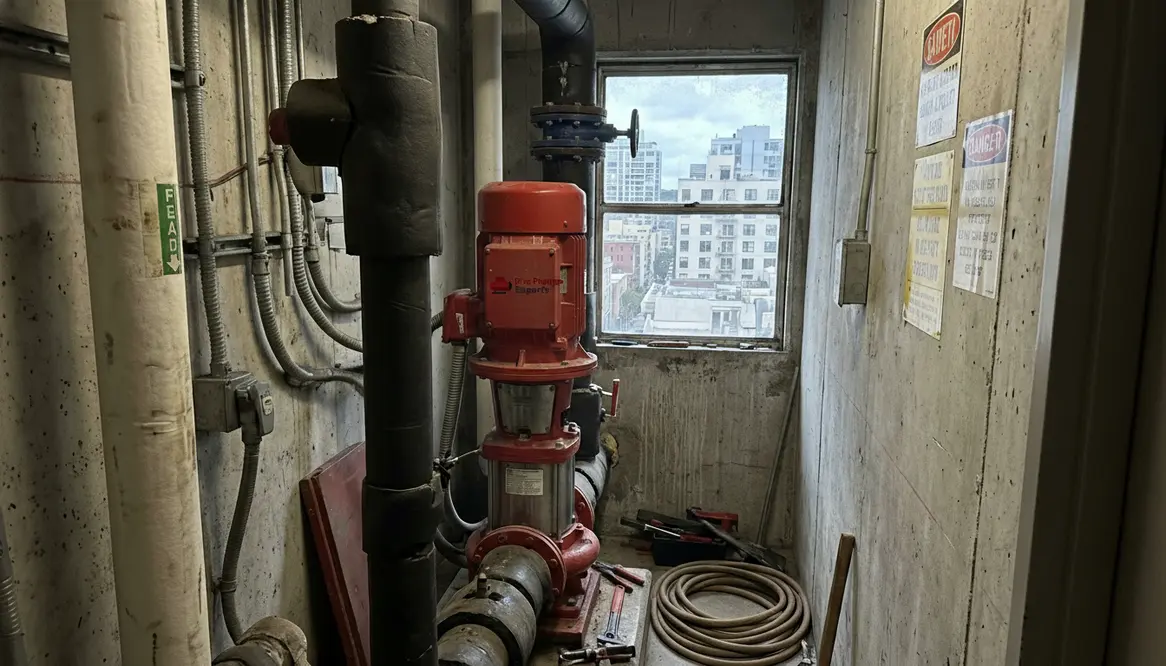
Vertical Inline Fire Pump Space Saving San Francisco
I have walked into more San Francisco mechanical rooms than I can count, and let me tell you, space is treated like gold. Every inch matters. That is exactly where vertical inline fire pump space saving San Francisco solutions step in and quietly save the day. They do not ask for attention. They just fit, perform, and keep buildings compliant without turning the room into a game of Tetris gone wrong. And honestly, if you have ever tried to squeeze a traditional pump into a tight footprint, you know the struggle feels a bit like assembling IKEA furniture without instructions.
Why mechanical rooms in San Francisco feel impossibly tight
San Francisco buildings come with personality. However, that charm often includes compact layouts, retrofitted systems, and strict building codes. Because of this, mechanical rooms rarely offer the luxury of expansion. I often see engineers forced to make hard choices between essential systems.
Moreover, seismic requirements add another layer of complexity. Equipment must be anchored, accessible, and spaced properly. As a result, bulky horizontal fire pumps can quickly become impractical. That is where a smarter configuration changes everything.
What makes vertical inline fire pumps ideal for tight spaces
I like to think of vertical inline pumps as the skyscrapers of fire protection equipment. Instead of spreading out, they build upward. Consequently, they occupy far less floor space while still delivering strong performance.
Unlike traditional split case pumps, these systems sit directly in the pipeline. Therefore, they eliminate the need for large bases and complex alignment. In many cases, I have seen them cut the required footprint by more than half.
Additionally, installation becomes simpler. With fewer components and a more compact design, crews can work faster and with less disruption. That matters a lot in occupied commercial and industrial buildings where downtime is not exactly popular.
Space, performance, and compliance in one package
In cramped mechanical rooms, every decision is a trade-off. The beauty of a vertical inline fire pump is that you are not just shrinking the equipment; you are simplifying the entire layout. That means easier pathways, cleaner routing, and less time arguing with clearances on a drawing set.
For teams trying to keep both fire marshals and facility managers happy, a well-planned vertical inline fire pump space saving San Francisco layout checks a lot of boxes at once.
How does a vertical inline fire pump save space in San Francisco buildings
The answer is refreshingly straightforward. A vertical inline fire pump space saving San Francisco approach reduces horizontal spread while maximizing vertical clearance. Because most mechanical rooms have at least some vertical headroom, this design uses space that would otherwise go unused.
Furthermore, the inline configuration removes the need for long suction and discharge piping runs. That means fewer turns, fewer fittings, and less congestion overall. If pipes could sigh in relief, this is where they would do it.
In addition, maintenance access improves. Technicians can reach key components without navigating a maze of equipment. That translates to faster service and fewer headaches.
Design advantages for commercial and industrial properties
When I work with large facilities, efficiency always drives decisions. Vertical inline systems deliver several benefits that go beyond just saving space.
Key advantages at a glance
- Reduced footprint which frees up room for other critical systems
- Simplified piping layout that lowers installation complexity
- Improved energy efficiency due to streamlined flow paths
- Faster installation timelines which minimize operational disruption
- Compliance with fire codes without sacrificing usable space
Because of these factors, I often recommend them for high rise buildings, manufacturing facilities, and large commercial properties. They fit the environment without forcing costly redesigns.
Comparing traditional vs vertical inline configurations
Sometimes, the best way to understand the value is to see the contrast clearly.
Traditional horizontal pumps
- Require large floor space
- Need precise alignment
- Involve more extensive piping
- Can complicate retrofits
Vertical inline pumps
- Use minimal floor area
- Align naturally within the pipeline
- Reduce piping complexity
- Adapt well to existing structures
It is not exactly Batman versus Superman, but the difference is just as obvious once you see it in action.
Planning a retrofit without losing your mind
Retrofitting in San Francisco requires strategy. I always start by evaluating available vertical clearance and existing pipe routing. From there, I determine how a vertical inline system can integrate without major structural changes.
Next, I coordinate with fire protection engineers to ensure compliance with local codes. Because regulations are strict, every detail matters. However, the compact nature of these pumps often simplifies approvals.
Finally, I focus on minimizing disruption. In active commercial or industrial environments, shutting down operations is not an option. Thankfully, the streamlined installation process helps keep everything moving smoothly.
FAQ quick answers for busy decision makers
You might be weighing whether a vertical inline fire pump space saving San Francisco layout really fits your project. These quick answers cover the most common questions that come up in design meetings.
Making space work smarter not harder
I have seen firsthand how the right equipment can transform a cramped mechanical room into a functional, efficient space. A vertical inline fire pump space saving San Francisco solution does exactly that. It works with the building instead of against it.
So if your facility feels like it is running out of room, do not force a bulky solution into a tight corner. Let a smarter design take the lead. Reach out today and discover how you can protect your property, stay compliant, and finally give your mechanical room some breathing space. Even in San Francisco, that is still possible.