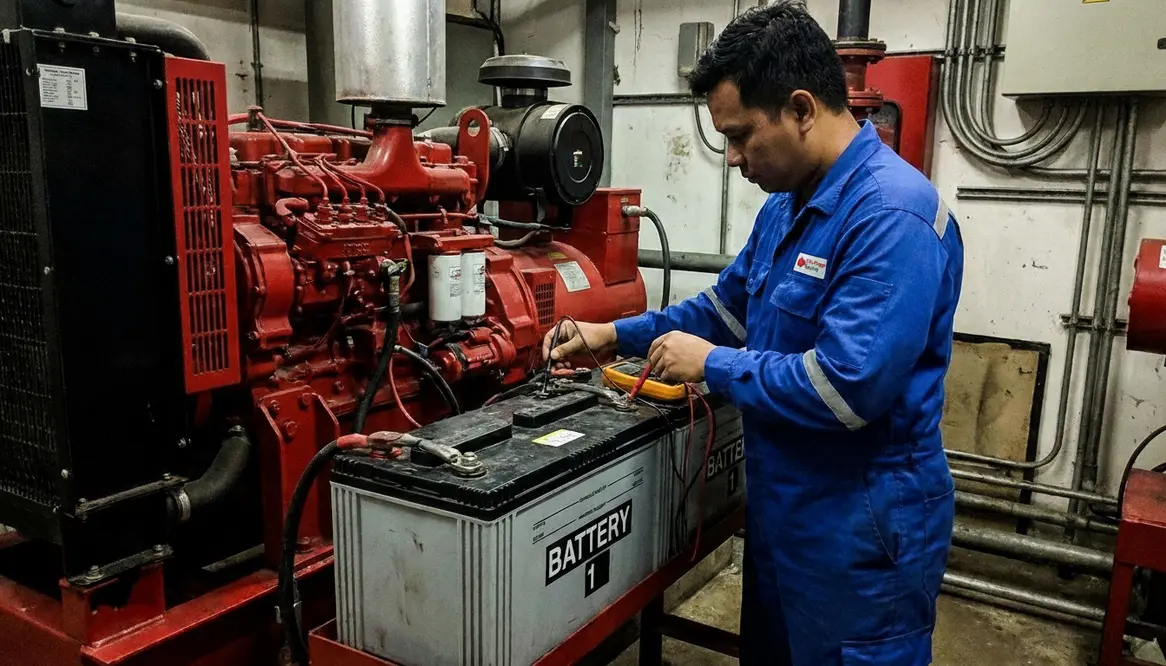
Battery 1 Diesel Fire Pump Start Checklist
What a Technician Looks for When a Diesel Fire Pump Won’t Start on Battery 1
When a diesel fire pump will not start on battery 1, I do not guess, and I do not rush. I start with the basics, because in fire protection, the small stuff loves to wear a disguise. A loose cable can act like a villain from a bad movie, and a weak battery can hide like it is auditioning for a spy role. For commercial and industrial facilities, and for major property buildings, that kind of failure is more than annoying. It can put the whole fire protection system in a bad spot. So I work through the system in a calm order, from power to controls to the starter itself.
That first check tells me a lot. If Battery 1 fails and Battery 2 starts the pump, then I already know the issue is likely local to the first battery path, not the whole engine. That is good news, because it means I can narrow the hunt and move with purpose.
Start With the Battery and Cables
I begin by checking Battery 1 voltage, terminal condition, and cable tightness. A battery can show enough voltage at rest and still fall flat when the starter asks for real power. That is the part people often miss. Under load, the truth comes out. If the voltage drops too fast, I look at the battery age, charge level, and internal condition.
Next, I inspect the cables. Corrosion, loose lugs, cracked insulation, and poor grounding can stop current before it reaches the starter. Even a small bit of corrosion can act like a stubborn gatekeeper. I clean the terminals, tighten the connections, and confirm the ground path. Then I test again. If the pump still will not crank, I move deeper.
Check the Control Circuit and Starter Path
Now I look at the control side. On many diesel fire pump systems, the problem is not the battery alone. Instead, the start signal never makes it cleanly to the starter. I check the start relays, selector switches, fuse links, and any safety interlocks tied to the first battery circuit. If one relay sticks or one contact burns, Battery 1 can look guilty when it is only the messenger.
I also test the starter solenoid and starter motor draw. If the solenoid clicks but the motor does not spin, the starter may be failing under load. On the other hand, if nothing clicks at all, I focus on the control path and the start contacts. In this job, silence is not golden. It is just a clue with a uniform on.
What a Technician Checks in Order
Battery side
- Battery voltage and load test
- Terminal corrosion and tightness
- Cable damage and ground path
- Charge condition and battery age
Starter side
- Start relay operation
- Solenoid response
- Fuse and interlock status
- Starter motor current draw
Look for Mechanical and Engine Issues
After the electrical checks, I make sure the engine itself can turn. A diesel fire pump can refuse to start because of low oil pressure lockout, a stuck component, or a mechanical bind in the engine or coupling. If the starter tries hard and the engine barely turns, I inspect the rotating parts and confirm the engine is free to move. Sometimes the problem hides in plain sight, like a stubborn doorknob that decides to fight on a Monday morning.
I also verify fuel supply, governor settings, and any engine alarm that may block startup. While Battery 1 may be the headline, another fault can be the real story. This is why I do not stop at the first obvious answer. I confirm each layer before I sign off the system.
Why Routine Testing Matters for Fire Pump Readiness
Routine testing saves time, money, and a lot of tension. It also helps me catch weak batteries before they fail during a real emergency. For commercial and industrial facilities, that matters every time. A diesel fire pump that starts on command keeps sprinkler systems ready and protects high value assets when the pressure is on.
I always recommend a service plan that includes battery testing, cable checks, control inspection, and full pump start verification. For related system support, I also point clients to diesel fire pump service for commercial buildings, and for electrical coordination, building fire pump electrical support helps keep the whole system in line. If you want a wider look at pump care, I suggest reviewing fire pump maintenance for major properties. For local information, I also reference los angeles diesel fire pump service when discussing broader pump support options.
FAQ
Conclusion
If your diesel fire pump will not start on battery 1, do not let the issue sit and smirk in the corner. I would inspect the battery, cables, control path, starter, and engine in order, then confirm the full system under test. That approach saves time and protects your building when it matters most. If you manage a commercial or industrial property, schedule a professional inspection now and keep your fire pump ready for the moment it has to perform.