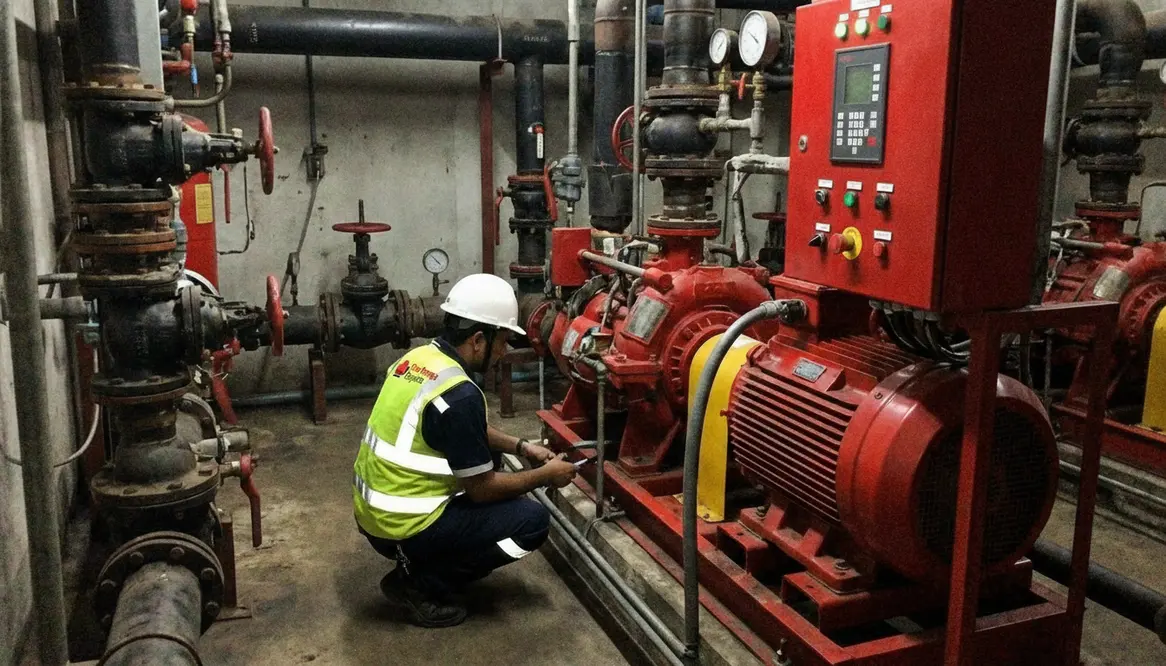
BS EN 12845 Fire Pump Acceptance Testing Guide
When I talk about BS EN 12845 testing, I am talking about the moment a fire pump must prove it can do the job when the pressure is on. Not later. Not “close enough.” Right now. For commercial and industrial facilities, and for major property buildings, this test gives me confidence that the sprinkler system will perform as designed when a real fire tries to ruin everyone’s day. In other words, this is not box ticking. This is survival with paperwork, and yes, the paperwork matters.
BS EN 12845 Fire Pump Acceptance Testing Overview
In this guide, I will walk through the full acceptance testing process, what I look for, and why a proper test protects people, property, and operations. I will keep it practical, because no one needs a lecture that sounds like a robot in a hard hat.
During BS EN 12845 testing, I focus on the full system picture. That means the pump, controller, water supply, valves, suction line, discharge line, and alarms must all work together. If one part drifts out of line, the whole setup can fail when it matters most. Therefore, I treat this test as a live proof of readiness, not a casual inspection with coffee in hand.
What BS EN 12845 Fire Pump Acceptance Testing Checks
Acceptance testing confirms that the fire pump meets the flow, pressure, and performance levels required by the system design. I check that the pump starts correctly, builds pressure fast enough, and holds stable output under load. I also confirm that the installation matches the approved plans, because a “nearly right” pump room is not a thing. The standard exists to make sure the pump can support the sprinkler system during a fire, not just sit there looking confident like a movie hero before the explosion.
If you want to go deeper into the standard itself, I recommend reviewing the official BS EN 12845 fire pump guidance from a reputable source such as https://firepumps.org so you can align your project with the right technical expectations. That extra step saves time later, and it keeps everyone singing from the same hymn sheet, which is rare in construction and therefore worth celebrating.
How I Prepare a Pump Room for Testing
Clearing the stage
Good results start before anyone opens a valve. First, I confirm the pump room is clean, clear, and fully accessible. Then I check that all labels, gauges, isolation points, and control panels are visible and in working order. If the room looks like a storage unit for forgotten cables and mystery boxes, I slow things down. That kind of clutter has a way of hiding real problems.
Lining up the numbers
Next, I review the design data and the acceptance criteria. I want the test team to know the target flow rates, pressure values, and run times before we begin. As a result, the test moves with less friction and fewer surprises. I also make sure the water supply is ready, because a fire pump without a solid supply is like a superhero with no power source. Impressive costume. Weak ending.
BS EN 12845 Testing Step by Step
Here is how I approach the acceptance test in a clear and controlled way:
- I verify the pump installation against the approved design and site conditions.
- I check suction conditions, water level, valves, and pipe support.
- I start the pump and confirm automatic and manual operation.
- I measure pressure and flow at the required duty points.
- I watch for vibration, leaks, unusual sound, and unstable control behavior.
- I test alarms, signals, and any remote monitoring points.
- I record the results and compare them with the acceptance standard.
During this stage, I keep an eye on pump response time. A delay can point to control faults, suction trouble, or poor setup. Also, I check that the pump can run without drama. A fire pump should not sound like it is auditioning for a role in a disaster film. It should run steady, firm, and predictable.
What Results Tell Me About System Readiness
Beyond just hitting the numbers
If the pump meets the required pressure and flow, that is a strong sign the system is ready for service. However, I do not stop at the numbers alone. I also look at how the pump behaves during the test. Stable readings matter, but so does smooth operation. If pressure swings too much, or if the controller struggles, I know I need to dig deeper.
Why this matters on real sites
For commercial and industrial sites, this matters even more because the fire risk can affect people, stock, machinery, and business continuity all at once. A failed pump test can delay commissioning, trigger repairs, and create extra cost. On the bright side, it is far better to find the issue now than during a real emergency. That is one trade I will always take.
Why Acceptance Testing Protects Major Buildings
Major property buildings rely on the sprinkler system as a core life safety measure. Therefore, I treat acceptance testing as a key part of building protection, asset protection, and legal compliance. It gives building owners proof that the fire pump can support the system under demand. It also gives fire engineers, facility teams, and insurers clear evidence that the installation meets the required standard.
A well-planned BS EN 12845 testing routine becomes the practical bridge between design intent and real-world fire protection. It shows that the pump, pipework, and controls do not just exist on drawings but perform as promised when the system is called into action.
Conclusion
If you are responsible for a commercial, industrial, or major property building, I urge you to treat acceptance testing as a priority, not a formality. A proper BS EN 12845 testing process gives you proof, control, and peace of mind. It also helps you catch weak points before they become expensive problems. So, if your fire pump needs a full acceptance check, get it done with care, record every result, and make sure your protection system stands ready when it counts.