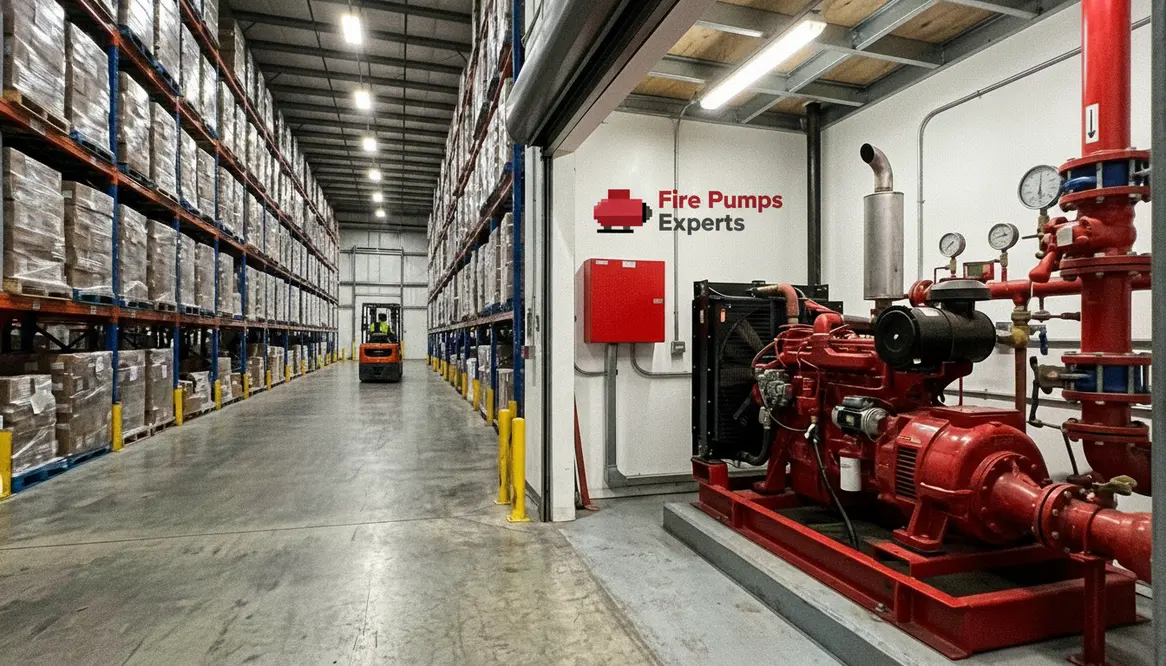
Fire Protection for Freight Handling and Staging
Smart, resilient fire protection starts long before alarms sound. In freight terminals, it starts with a fire pump that is ready for the worst day your operation will ever see.
I have walked through enough freight terminals to know one thing for certain. When everything moves fast, risk moves faster. That is exactly why Fire protection for freight handling and staging is not just a box to check. It is the backbone of operational safety. In these large, high value environments, a fire pump is not a luxury. It is the quiet guardian waiting in the wings in a movie where you know the voiceover is about to explain everything that matters.
So let me take you through what really matters when it comes to fire pump requirements in freight terminals, and yes, I promise to keep it more engaging than a stack of compliance paperwork.
What fire pump capacity does a freight terminal actually need
I get this question a lot, and the answer is not one size fits all. However, I can tell you this right away. Freight terminals demand high capacity systems because of open floor plans, stacked goods, and constant vehicle movement.
These are not calm, low-risk boxes on a site plan. They are constantly in motion, which means any fire event can spread faster than you think.
How I frame the capacity question
Typically, I look at:
- Flow demand based on sprinkler system design
- Pressure requirements to reach the most remote areas
- Water supply reliability since city pressure alone rarely cuts it
Then, I size the pump to exceed those needs, not just meet them. Because when a fire starts, there is no time for “almost enough.” And frankly, hoping your municipal supply shows up like a superhero is a gamble I would not take.
Fire protection for freight handling and staging in high hazard zones
Now let us get into the heart of the operation. Freight terminals are not calm storage spaces. They are active, unpredictable, and sometimes chaotic. Pallets shift, forklifts move, and materials vary daily.
Because of this, I always classify many areas as higher hazard. That means:
- Higher density sprinkler systems
- Stronger fire pump output
- Redundant system considerations
Why staging areas are different
Additionally, staging areas often hold mixed commodities. One day it is electronics. The next day it is something far more flammable. Therefore, I design fire pump systems that can handle the worst case scenario, not the average Tuesday.
It is a bit like preparing for a plot twist. If you have seen enough movies, you know it is coming. Fire protection for freight handling and staging has to be scripted for the twist, not the opening credits.
Key components I never compromise on
When I design or review a system, there are a few elements I treat as non negotiable. These are not bells and whistles. They are essentials.
- Reliable power source such as diesel or backup generators
- Automatic start functionality so there is no delay
- Controller systems that meet strict industrial standards
- Routine testing access because a pump that is not tested is just expensive decoration
Moreover, I always consider maintenance access. If your team cannot easily reach and service the pump, it will eventually fail you. And that failure will not happen at a convenient time.
Common Mistake
- Undersizing the pump to save upfront cost
- Ignoring backup power needs
- Poor placement in hard to reach areas
Better Approach
- Design for peak demand and future growth
- Install reliable secondary power sources
- Ensure clear access for inspection and repair
How layout and flow impact pump performance
Freight terminals are not neat grids. They are sprawling, dynamic spaces with loading docks, storage racks, and open staging zones. Because of this, I pay close attention to layout.
The further water has to travel, the more pressure you lose. So I calculate friction loss across long pipe runs and adjust pump output accordingly. Additionally, I factor in elevation changes, even small ones, because gravity is not interested in your deadlines.
Coordinating with the rest of the system
Furthermore, I coordinate closely with sprinkler designers. The pump and sprinkler system must work as a team. Otherwise, you end up with a system that looks great on paper but struggles in real life. And real life is where it counts.
Fire protection for freight handling and staging works best when the fire pump is treated as the heart of the system, not an accessory. Every pipe run, every riser, and every staging zone should be planned around giving that pump the best chance to do its job.
Fire protection for freight handling and staging and compliance expectations
Let us talk about compliance, because yes, it matters, even if it does not make for thrilling dinner conversation.
I align every fire pump system with standards like NFPA 20 and relevant local codes. However, I do not stop there. Freight terminals often fall under stricter scrutiny due to their scale and risk profile.
Turning compliance into an asset
- Inspection routines are clearly defined
- Testing schedules are realistic and enforced
- Documentation is complete and accessible
Because when inspectors show up, and they will, you want confidence, not confusion. Think of it like showing up to an exam where you actually studied. A rare but satisfying experience.
If you treat Fire protection for freight handling and staging as a living, documented system instead of a one-time project, inspections become a checkpoint, not a crisis.
FAQ
Final thoughts and next steps
If you run or manage a freight terminal, I would not leave fire pump design to chance. The right system protects your people, your cargo, and your bottom line. More importantly, it gives you confidence when it matters most. If you are ready to strengthen your fire protection strategy, now is the time to act. Work with experts who understand large scale industrial facilities and build a system that performs when everything else is on the line.
If you want a deeper technical reference on pumps themselves, resources like https://firepumps.org can help you speak the same language as your design team while you shape a strategy that truly supports Fire protection for freight handling and staging.