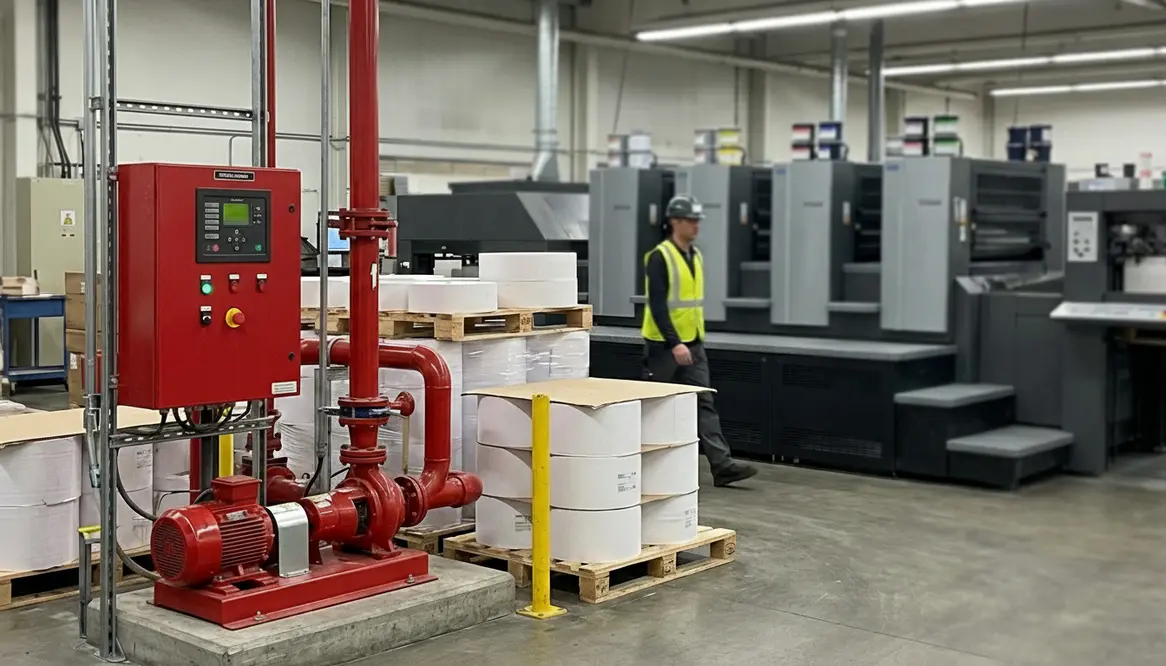
Fire Pump Design for Ink Paper and Equipment Areas
I have spent enough time walking through printing facilities to know one thing for certain. Ink may tell the story on paper, but fire protection decides whether that story ever gets finished. When I talk about Fire pump design for ink, paper, and equipment areas, I am not talking about a one size fits all system. I am talking about a tailored, deliberate approach that respects how these spaces actually work. Because in a facility filled with paper stacks, solvents, and high heat equipment, fire does not ask for permission. It simply shows up.
So let’s take a steady walk through what truly works and why the right system matters more than most people think.
What makes printing facilities uniquely vulnerable to fire risks?
Printing plants carry a quiet tension. On one side, you have massive paper storage that burns fast and hot. On the other, you have inks, coatings, and solvents that can ignite even faster. And then, of course, there is the equipment itself running at high speeds and temperatures.
Because of this mix, a standard fire system often falls short. Instead, I approach protection by breaking the facility into zones. Ink storage behaves differently than paper warehouses. Press areas introduce heat and friction. Each space demands its own response.
That is where a thoughtful fire pump system for printing environments comes into play. It ensures water pressure and flow remain consistent even when multiple hazards demand attention at once. And yes, when everything hits at the same time, you want your system to perform like a seasoned actor, not a nervous extra.
Fire pump design for ink, paper, and equipment areas that actually works
I do not believe in guesswork. A strong Fire pump design for ink, paper, and equipment areas starts with understanding fuel load, layout, and operational flow. Then, I align pump capacity with worst case scenarios, not average days.
For ink zones, I focus on rapid suppression. These areas often require higher discharge density due to flammable liquids. Meanwhile, paper storage calls for sustained water delivery over a longer period. It is not about speed alone. It is about endurance.
Equipment zones present a different challenge. Presses and dryers generate heat, so I plan for quick activation and consistent pressure. In these areas, delays can mean escalation.
And here is the part people underestimate. Coordination. If systems compete for pressure, the whole design weakens. I make sure the pump supports all zones without compromise. Think of it as directing an orchestra. Every section plays its part, but the conductor keeps it all in sync.
How do I size a fire pump for a large printing facility?
I start with demand calculations. Not guesses. Not rules of thumb. Actual hydraulic data based on hazard classification and system layout.
Then I consider simultaneous demand. Because fires do not politely stay in one corner. I ensure the pump can handle multiple systems activating at once. Sprinklers, hose stations, and sometimes foam systems.
After that, I evaluate water supply. Municipal systems are not always reliable under peak demand. So I often recommend a dedicated supply paired with a pump that can maintain pressure even when the grid dips.
And yes, I leave room for growth. Printing facilities expand. Equipment upgrades. Storage increases. A system that cannot scale is a system that will eventually fail.
Key sizing factors I prioritize
- Peak simultaneous demand
- Hazard specific flow requirements
- Water supply reliability
- Future facility expansion
Common mistakes I avoid
- Undersized pumps based on averages
- Ignoring ink and solvent hazards
- Poor zoning coordination
- No allowance for system growth
Why reliability matters more than raw power
A powerful pump looks impressive on paper. But reliability is what saves buildings.
I focus on redundancy, proper maintenance access, and control systems that respond without hesitation. Electric pumps are common, but diesel backups often provide an extra layer of security, especially in large industrial properties.
Additionally, I design systems that operators can understand. Because in an emergency, no one wants to decode a control panel like it is a puzzle from an escape room.
Routine testing also plays a role. A well designed system that is never tested is like a superhero who refuses to leave the couch. Technically capable, but not exactly helpful.
Integrating fire pumps with modern printing operations
Today’s printing facilities rely heavily on automation. That means fire protection must integrate smoothly without disrupting operations.
I often align pump systems with monitoring technology that provides real time feedback. This allows facility managers to track pressure, flow, and system health instantly. When something drifts out of range, they know before it becomes a problem.
Additionally, zoning strategies ensure that activation in one area does not shut down the entire operation. This balance between protection and continuity is critical for large commercial and industrial facilities.
Because let’s be honest. Downtime costs money. And while safety comes first, smart design ensures you are not sacrificing productivity unnecessarily.
Practical considerations in Fire pump design for ink, paper, and equipment areas
In real facilities, the theory of Fire pump design for ink, paper, and equipment areas meets forklifts, shift schedules, and pallets stacked higher than anyone will admit. So I pay attention to access routes, control room locations, and how people actually move through the building.
In ink and solvent rooms, I coordinate with ventilation and containment features. The pump and suppression system must be ready to control a spill fire without pushing burning liquid into other areas. In paper storage, I account for rack arrangements, aisle widths, and whether high piled storage is likely to change over time.
For equipment areas, especially around presses and dryers, I look closely at where ignition is most likely. Bearings, electrical cabinets, and web breaks can all trigger fast moving events. The fire pump’s job is to ensure the suppression systems at those locations never starve for pressure.
Good Fire pump design for ink, paper, and equipment areas also respects inspection and maintenance realities. Valves must be reachable. Test headers should be accessible. If technicians dread working around the system, testing gets skipped and reliability quietly erodes.
Training, monitoring, and long term performance
Even the best engineered systems depend on people. Operators should know what normal pump operation looks and sounds like, what alarms matter most, and how to respond without improvisation. I always recommend straightforward procedures that match the actual panel layout and field conditions.
On the monitoring side, tying fire pump performance into a central system or remote dashboard gives leadership real visibility. Pressure drops, unexpected starts, or abnormal run times become early warnings instead of mysteries discovered after an incident.
Over time, data from testing and real operations tells a story. It highlights whether Fire pump design for ink, paper, and equipment areas is still aligned with the facility as it grows, adds presses, or changes materials. When the data and the design drift apart, it is time for an upgrade, not a wish.
FAQ
Bringing it all together
When I design systems for printing facilities, I do not chase trends. I focus on performance, reliability, and clarity. A well executed approach to fire pump systems for ink, paper, and machinery zones ensures that every part of the operation stays protected without compromise.
If you are managing a commercial or industrial printing facility, now is the time to take a closer look at your fire protection strategy. A properly designed system does more than meet code. It protects your people, your equipment, and your future. Reach out today and let’s build a solution that works when it matters most.