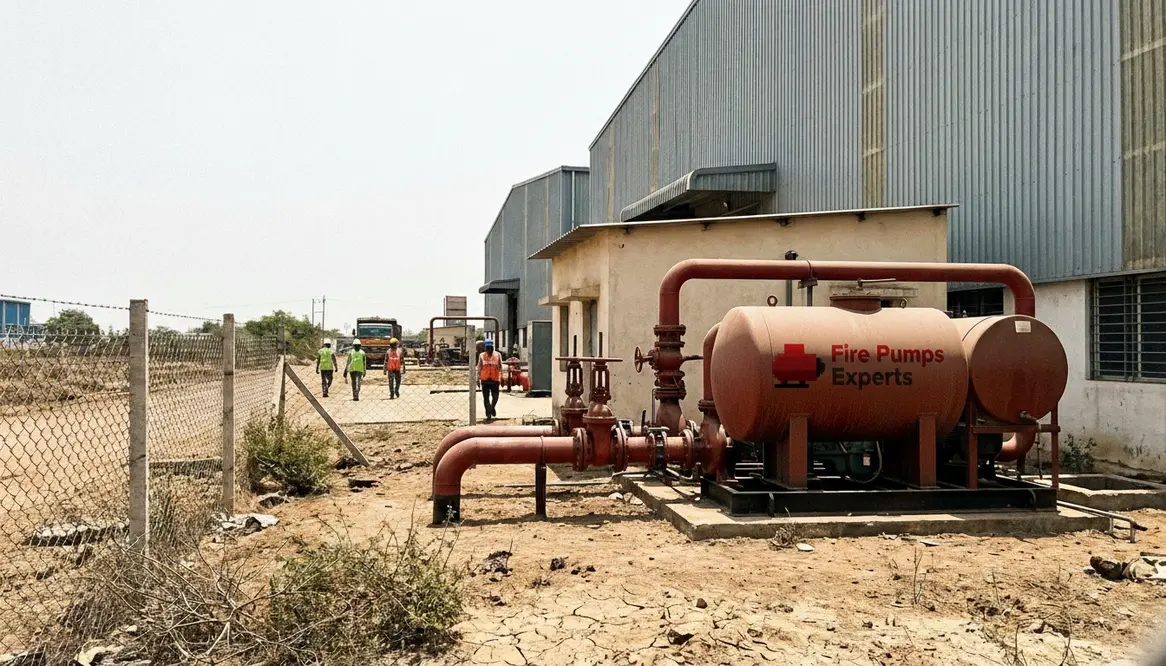
Fire Pump Hazardous Storage India Design Guide
I have spent years around industrial facilities, and if there is one thing I have learned, it is this: fire does not negotiate. When we talk about fire pump hazardous storage India, we are stepping into a world where risk is not theoretical. It is stacked in racks, sealed in drums, and humming quietly behind warehouse doors. So I approach this topic with calm seriousness and just a hint of humor, because if we cannot smile while planning for worst case scenarios, we might as well let the fire win. And trust me, it does not need the confidence boost.
Understanding Risk in High Hazard Storage Environments
High hazard storage is not your average warehouse setup. I am talking about flammable liquids, chemicals, plastics, and tightly packed materials that burn fast and hot. Therefore, the fire load increases dramatically, and standard systems simply cannot keep up.
In India, industrial zones often combine dense storage with high ambient temperatures. As a result, ignition spreads faster than most people expect. I have seen facilities underestimate this, assuming a basic pump setup will do the job. It will not.
Moreover, storage height plays a major role. The higher the racks, the more complex the suppression challenge becomes. Consequently, fire pumps must deliver not just water, but pressure and consistency that matches the hazard profile. Think of it like upgrading from a garden hose to something Batman would keep in the Batcave.
How do I size a fire pump for hazardous storage in India?
Starting with hazard classification
I get this question a lot, and the answer is both simple and layered. First, I look at hazard classification. Then I align with standards like NFPA and local Indian fire codes. However, I never stop there.
Flow, duration, and real demand
I calculate required flow rates based on sprinkler demand, hose allowances, and duration. Additionally, I consider worst case scenarios rather than average conditions. Because let us be honest, fire does not show up on a good day when everything works perfectly.
Why pressure makes or breaks the system
Pressure is equally critical. If your pump cannot maintain pressure across the entire system, you end up with dry zones. And that is where fires like to throw a party.
So I always recommend testing system curves against real site conditions. Not theoretical ones. Not brochure numbers. Real conditions.
Fire Pump Hazardous Storage India Design Priorities
When I design systems for fire pump hazardous storage India, I focus on reliability first, performance second, and simplicity third. Because in an emergency, complexity is the enemy.
Reliable power supply
I prefer diesel driven pumps or dual power setups. Power outages are not rare, and fire does not wait for electricity to come back.
Redundancy where it matters
I always include backup pumps. If one fails, another must take over instantly. Think of it as having a stunt double ready for the dangerous scenes.
Hydraulic balance and coverage
I ensure even water distribution across zones. Otherwise, one area gets flooded while another burns quietly in protest.
Material compatibility in harsh environments
Corrosion resistance matters, especially with chemical storage. Equipment should last, not rust into retirement.
Common Mistakes I See in Industrial Fire Pump Systems
Undersized pumps to “save money”
Now, here is where things get interesting. Because mistakes are not rare. In fact, they are almost predictable.
First, undersized pumps. Many facilities try to save upfront costs. However, they end up paying far more when systems fail under pressure. Literally.
Maintenance treated as optional
Second, poor maintenance planning. A fire pump is not a decorative item. It needs regular testing, inspection, and servicing. Otherwise, it becomes a very expensive paperweight.
Ignoring system integration
Third, ignoring system integration. Fire pumps must work seamlessly with sprinklers, hydrants, and alarms. If they do not communicate well, the system behaves like a confused orchestra.
Controls that confuse everyone
And finally, overcomplicating controls. I have seen panels that look like spaceship dashboards. In an emergency, nobody has time to figure out which button launches the rocket.
Practical Setup Insights for Industrial Facilities
What I prioritize on site
- Consistent water source availability
- Clear access for maintenance teams
- Protection from environmental exposure
- Straightforward control layouts
What I avoid at all costs
- Over reliance on single power sources
- Hidden or hard to reach pump rooms
- Complex piping with pressure losses
- Neglecting future expansion needs
Additionally, I always plan for scalability. Industrial operations grow. Storage expands. Risk increases. Therefore, the fire pump system should be ready to evolve without a complete overhaul.
Fire Pump Hazardous Storage India Compliance and Standards
Compliance is not just a checkbox exercise. It is a survival strategy. In India, I align systems with national building codes, TAC guidelines, and international benchmarks like NFPA, always keeping the realities of fire pump hazardous storage India firmly in view.
However, I do not treat standards as rigid rules. Instead, I use them as a foundation. Then I adapt based on site specific risks. Because no two facilities are identical.
Regular audits also play a major role. I recommend periodic third party evaluations. They bring fresh eyes and often catch issues internal teams miss. It is like having a film critic review your system before the audience does.
FAQ
Conclusion
If you are managing or building an industrial facility, do not treat fire protection as an afterthought. I encourage you to invest in the right fire pump strategy, tailored specifically for high hazard storage risks. Work with experts who understand industrial complexity and design systems that perform under pressure. Because when the moment comes, your fire pump should not hesitate. It should act. And it should win. And if you ever doubt whether the details are worth the effort, remember that in the world of fire pump hazardous storage India, the small decisions made today decide how well you sleep tomorrow.