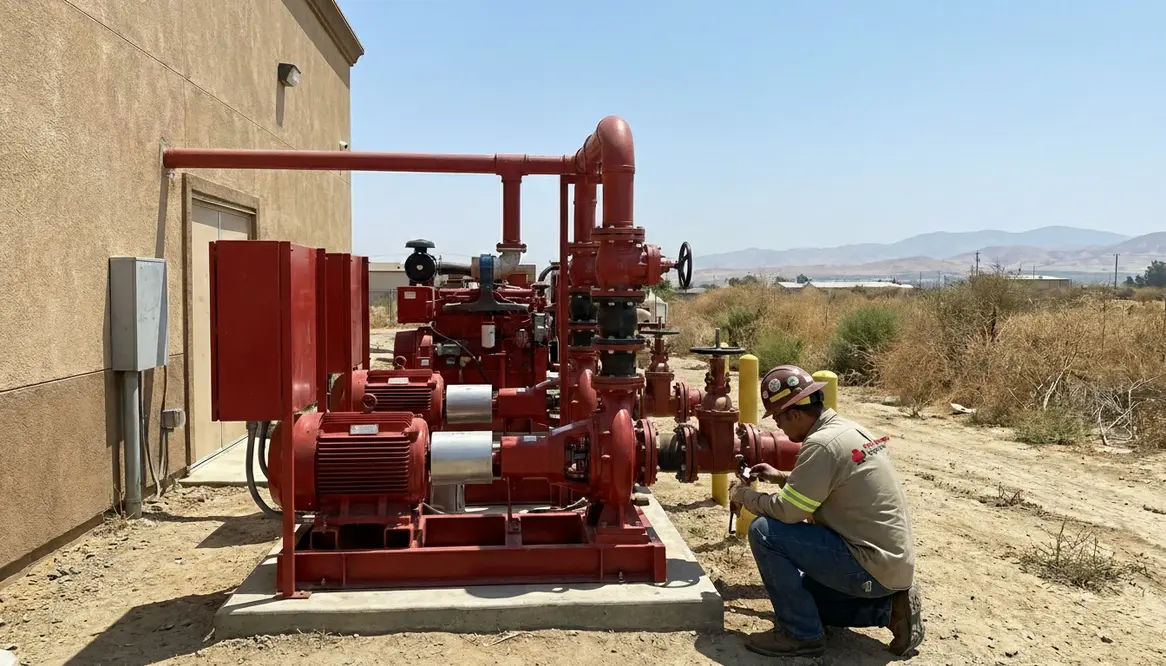
Fire Pump Reliability in Kern County Wildfires
I’ve spent years around critical infrastructure, and I’ll tell you this plainly. Fire protection is not the place to cut corners, especially in a region like Kern County where wildfire season feels less like a season and more like a recurring guest that never quite leaves. While working alongside teams involved in New Jersey fire pump installation, I’ve seen what reliability really looks like when systems are built with intention. That same level of discipline is exactly what facilities in wildfire prone zones need, because when fire shows up, it does not RSVP.
Why wildfire risk in Kern County demands serious fire pump performance
Kern County brings together heat, wind, and dry terrain in a way that practically writes love letters to wildfires. Therefore, commercial and industrial facilities here face a unique challenge. It is not just about having a fire pump. It is about having one that works flawlessly under stress.
When a wildfire pushes toward a property, water demand spikes instantly. Sprinkler systems, hydrants, and suppression lines all rely on steady pressure. If a pump hesitates, stalls, or underperforms, the entire system becomes a very expensive decoration. And let’s be honest, no facility manager wants their fire system to behave like a WiFi signal during a storm.
Because of this, reliability is not a luxury. It is the backbone of survival.
How does a fire pump actually protect large facilities during a wildfire?
A fire pump acts as the muscle behind your fire protection system. While municipal water supplies can fluctuate, especially during widespread emergencies, the pump ensures consistent pressure and flow. In large scale properties like manufacturing plants, warehouses, and processing facilities, that consistency is everything.
Additionally, these systems must respond instantly. There is no warm up period. No second chances. The pump must activate, deliver pressure, and sustain it for as long as the threat exists.
From my experience, the difference between a controlled incident and a catastrophic loss often comes down to how well that pump performs in the first few minutes. And those minutes go by faster than a movie villain monologue.
Lessons I have seen from New Jersey fire pump installation projects
Working on projects tied to New Jersey fire pump installation taught me something valuable. Reliability starts long before the pump is ever turned on. It begins with design, continues through installation, and lives on through maintenance.
In those projects, teams focused heavily on precision. Alignment, calibration, and testing were treated as non negotiables. Consequently, systems performed exactly as expected when tested under pressure.
Kern County facilities can take a page from that playbook. While the environments differ, the principle remains the same. Build it right, test it thoroughly, and maintain it like your business depends on it. Because it does.
If you are planning a New Jersey fire pump installation or updating systems in wildfire country, the blueprint is identical: treat reliability as a design requirement, not a nice-to-have feature.
What makes a fire pump reliable in extreme wildfire conditions
Power, sizing, and durability
Consistent power supply
A reliable pump needs a dependable power source. Backup generators are not optional. They are essential.
Proper system sizing
Oversized or undersized pumps create inefficiencies. Correct sizing ensures optimal pressure during peak demand.
Durable components
Heat, debris, and long run times demand equipment that can handle stress without failure.
Testing, controls, and redundancy
Routine testing
Regular performance tests reveal issues before they become emergencies.
Smart controls
Modern control panels provide real time monitoring and faster response times.
Redundancy planning
Backup systems ensure that if one component fails, another takes over seamlessly.
Together, these elements create a system that does not just function, but endures. And in wildfire scenarios, endurance is everything.
The hidden risks of neglecting fire pump maintenance
Now here is where things get uncomfortable. Many facilities install excellent systems and then treat maintenance like an optional gym membership. It sounds good in theory, but it rarely happens consistently.
However, neglect shows up at the worst possible moment. Seals degrade, valves stick, and engines fail to start. These are not dramatic issues during routine inspections, but during a wildfire, they become critical failures.
I have seen facilities assume everything was fine simply because the system had not been used. That logic is about as reliable as assuming your car will run perfectly after sitting untouched for years. Spoiler alert. It will not.
Instead, proactive maintenance ensures that every component is ready when called upon. And in high risk regions, readiness is the only acceptable state.
If you want a real world picture of disciplined maintenance and testing, look at how serious contractors manage a New Jersey fire pump installation over its life cycle. The same mindset applies in Kern County, even if the hazard profile is different.
Why commercial and industrial properties need a higher standard
Large facilities carry greater responsibility. They house valuable assets, support supply chains, and employ significant workforces. Therefore, the impact of fire extends far beyond the building itself.
Because of this, fire pump systems must meet higher standards of performance and resilience. It is not just about compliance. It is about continuity.
Moreover, insurers and regulators increasingly expect robust fire protection strategies. Facilities that invest in reliable systems position themselves better for both safety and long term operational stability.
And let’s face it, peace of mind is hard to price. But it is easy to appreciate when everything works exactly as it should.
If you are looking for deeper guidance on compliant system design and performance, resources like NFPA 20 fire pump standards and hands-on experience from projects such as New Jersey fire pump installation work together to raise the bar on what “reliable” really means.
FAQ
Stay ready before the next wildfire arrives
If you manage a commercial or industrial facility in Kern County, now is the time to act. Evaluate your fire pump system, invest in proper maintenance, and ensure every component performs under pressure. The difference between preparation and regret often comes down to a single decision made today.
Reach out to experienced professionals who understand high demand environments and build systems that hold the line when it matters most. Whether you are budgeting for upgrades in Kern County or mapping out a New Jersey fire pump installation hundreds of miles away, the goal is the same: a system that is ready every single time it is needed.