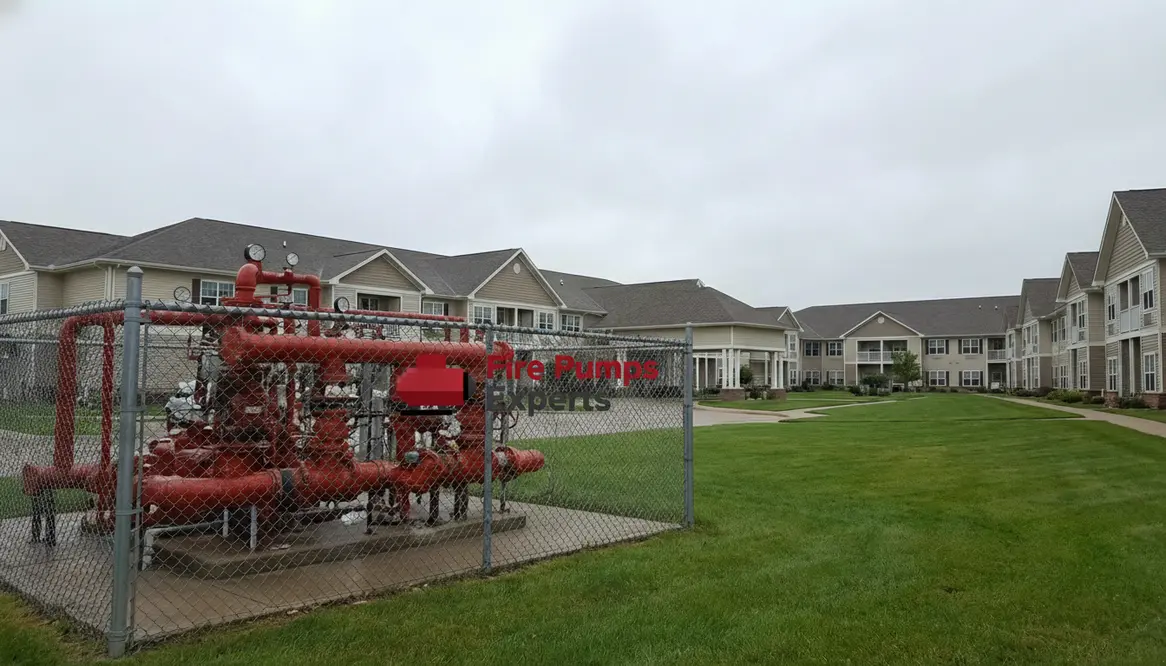
Fire Pump Requirements for Senior Living Campuses
Fire pump design for large retirement campuses is not just a technical task. It is a responsibility that sits quietly in the background, waiting for the moment it matters most. When I think about Fire Pump Requirements for Senior Living Communities, I see more than pipes and pressure curves. I see long hallways, quiet rooms, and people who depend on systems they will hopefully never notice. And yet, those systems must perform flawlessly. So, let me walk you through how I approach it, with a steady hand and just enough humor to keep us awake.
What makes fire pump systems different in large retirement campuses
First, scale changes everything. A retirement campus is not a single building. It is often a network of residential wings, medical spaces, dining areas, and sometimes even theaters where someone is definitely watching an old classic for the tenth time.
Because of that, I design with distribution in mind. Water must travel farther, and it must arrive with consistent pressure. Therefore, zoning becomes essential. I break the campus into manageable sections so that one demand does not cripple the entire system.
Redundancy and resilience
Additionally, redundancy is not optional. If one pump fails, another must take over without hesitation. In environments where mobility is limited, response time is everything. So, I plan for failure before it ever happens. It is a bit like bringing an umbrella on a sunny day. You might look odd, but you will thank yourself later.
Campus-wide performance
Systems must support long corridors, multiple floors, and mixed-use spaces without starving any branch of pressure. That is why Fire Pump Requirements for Senior Living Communities are approached as a campus strategy, not a single-building checklist.
Fire Pump Requirements for Senior Living Communities and how I meet them
Beyond minimum code
Now, let us talk about the core of it all. Fire Pump Requirements for Senior Living Communities demand reliability, clarity, and compliance with strict codes. However, meeting code is only the baseline. I go further.
I select pumps that handle peak demand with room to spare. Then, I ensure the system accounts for sprinkler coverage, standpipes, and any specialized suppression systems used in healthcare areas.
Power and control strategy
Moreover, power supply matters. I often recommend dedicated backup generators because outages do not send polite warnings. They arrive uninvited, like a plot twist in a thriller movie.
Control panels must also be intuitive. In a high stress moment, no one wants to decode a complex interface. So, I keep controls straightforward and accessible.
How do I size a fire pump for a retirement campus
Starting with demand and hydraulics
I start with demand calculations. That means understanding the most hydraulically demanding area of the campus. Then, I factor in elevation changes, friction loss, and simultaneous system use.
Finding the right pump curve
After that, I match the pump curve to those needs. Not too small, not excessively large. Oversizing might sound safe, but it can cause pressure issues and system wear over time. So, balance is key.
Designing for future wings and growth
Next, I consider future expansion. Retirement campuses grow. New wings appear, and services expand. Therefore, I design with scalability in mind, so the system does not become obsolete the moment construction crews return.
Design strategies that improve long term reliability
Reliability does not happen by accident. It is built into every decision.
Smart Layout Choices
- Centralized pump rooms for easier access
- Clear piping routes to reduce friction loss
- Isolation valves for targeted maintenance
Operational Advantages
- Faster inspections and repairs
- Reduced downtime during maintenance
- Consistent system performance
Monitoring and early warning
In addition, I integrate monitoring systems. These provide real time data, allowing facility managers to detect issues before they become emergencies. It is like having a watchful guardian that never sleeps, minus the dramatic music.
Balancing compliance, cost, and peace of mind
Every project comes with a budget. However, cutting corners on fire protection is a gamble I refuse to take. Instead, I focus on smart investments.
For example, high efficiency pumps may cost more upfront, yet they reduce energy use over time. Similarly, durable components extend system life and reduce maintenance costs.
At the same time, I ensure full compliance with codes and standards. That includes NFPA guidelines and local regulations. Because while creativity has its place, fire protection is not the arena for improvisation. This is not jazz. It is orchestration, precise and deliberate.
Fire Pump Requirements for Senior Living Communities in modern campus expansions
Expansion projects introduce unique challenges. Existing systems must integrate with new infrastructure without disruption. Therefore, I assess current capacity before adding anything new.
Often, upgrades are necessary. Pumps may need replacement, or piping may require reinforcement. In some cases, I introduce secondary pump systems to support new buildings.
Furthermore, I ensure seamless communication between old and new components. A disconnected system is a liability. Everything must work together as one, like a well cast ensemble where no actor misses their cue.
If you are comparing design approaches, resources such as https://firepumps.org provide useful benchmarks, but each campus still needs a tailored strategy to fully satisfy Fire Pump Requirements for Senior Living Communities.
FAQ
Conclusion
Designing fire pump systems for large retirement campuses is about more than meeting codes. It is about creating a quiet layer of protection that stands ready at all times. If you are planning a new development or upgrading an existing property, I can help you build a system that delivers strength, reliability, and confidence. Reach out today, and let us design something that works when it matters most.