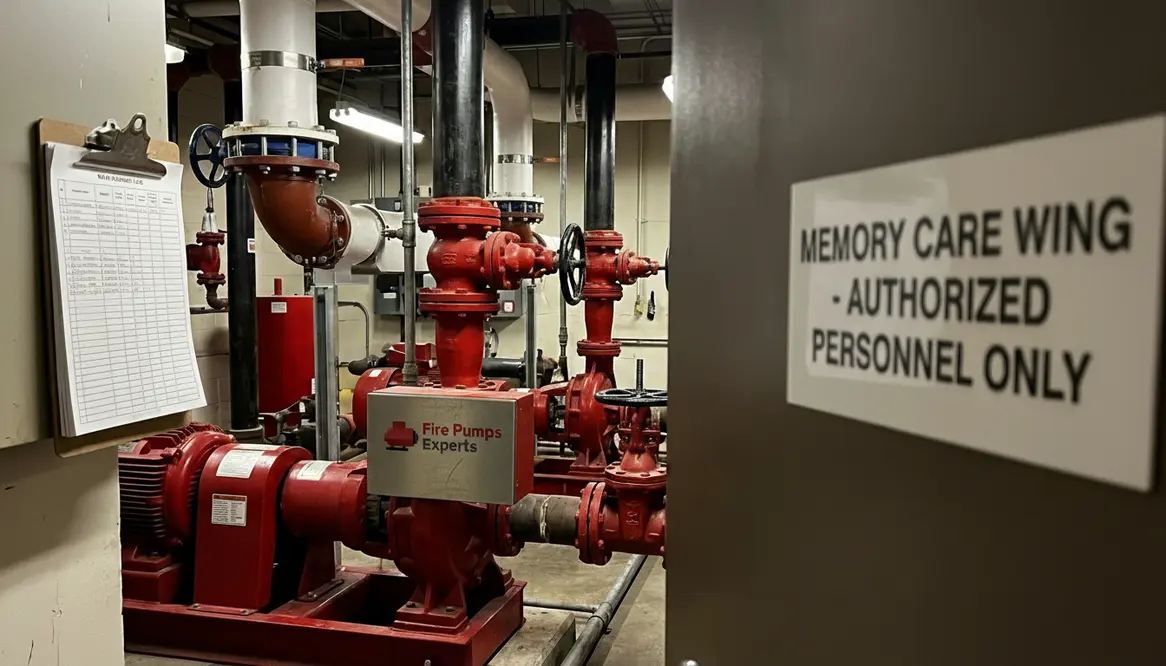
Fire Pump Systems for Memory Care Facility Safety
I have spent enough time around commercial buildings to know one simple truth. Safety is never one size fits all. When we talk about protecting vulnerable occupants, the conversation deepens. It slows down. It becomes more human. And yes, it becomes more complex. That is where Fire Pump Systems for Memory Care Facilities quietly step into the spotlight. Not as flashy heroes, but as steady guardians working behind the walls. In facilities where residents may not remember the sound of an alarm, every second matters, and every system must think ahead.
Understanding Vulnerable Occupants in High Risk Environments
Not all occupants respond to danger the same way. In fact, some cannot respond at all without assistance. I am talking about individuals in memory care units, rehabilitation centers, and large scale healthcare facilities. These are environments where mobility is limited and cognitive awareness can be inconsistent.
Because of that, life safety systems must carry more responsibility. They must compensate for delayed reactions, confusion, or even fear. While a typical office worker might exit quickly during an alarm, a resident with memory loss might hesitate, wander, or simply not understand what is happening. That difference shapes everything.
Therefore, fire protection design shifts from basic compliance to intentional care. It becomes less about checking boxes and more about anticipating human behavior.
How Fire Pump Systems for Memory Care Facilities Support Immediate Response
Water is still the most reliable firefighter we have. However, without proper pressure and delivery, even the best sprinkler system becomes little more than decorative plumbing. That is why Fire Pump Systems for Memory Care Facilities are critical in larger commercial properties.
These systems ensure that water reaches every corner of a building with enough force to suppress a fire quickly. More importantly, they reduce the time between ignition and control. In a setting where evacuation may take longer, that time savings is everything.
And let me be clear. Fires do not politely wait for staff to organize a response. They move fast, like a plot twist in a thriller movie. So, the system has to move faster.
Additionally, modern fire pump solutions integrate with alarms and monitoring systems. As a result, they activate automatically, removing the need for human intervention during those first critical moments.
Designing for Delayed Evacuation Realities
I have seen building plans that assume people will exit in neat, orderly lines. That is a nice idea. It is also fiction in many care environments.
In memory care settings, evacuation is often phased and assisted. Staff must guide residents, sometimes one by one. Therefore, buildings must be designed to protect occupants in place for longer periods.
That is where compartmentalization comes in. Fire rated walls, smoke barriers, and controlled airflow work together to contain danger. Meanwhile, fire pumps support suppression systems that keep conditions survivable.
So instead of rushing everyone out immediately, the building buys time. And in life safety, time is the most valuable currency you will ever spend.
What features should I prioritize for vulnerable occupant fire safety?
I get this question a lot, and the answer is refreshingly practical.
Core system priorities
- Reliable fire pump capacity for full building coverage
- Automatic activation with backup power
- Integrated alarm and monitoring systems
- Zoned sprinkler control for targeted suppression
Human centered considerations
- Clear staff protocols and training
- Simple and intuitive alarm cues
- Safe refuge areas within the building
- Redundant systems to prevent single point failure
Notice how technology and human behavior sit side by side. One without the other is like Batman without Alfred. Technically impressive, but missing the support that makes it all work.
Maintenance and Testing Are Not Optional Extras
Here is a truth that does not get enough attention. A system that is not maintained is a system that will fail when you need it most.
Fire pumps, in particular, demand regular testing. Flow tests, pressure checks, and controller inspections ensure that performance stays consistent. In large commercial properties, even a small drop in pressure can reduce effectiveness across multiple floors.
Furthermore, facilities that house vulnerable occupants cannot afford surprises. Consistency is the goal. Predictability is the standard.
I like to think of maintenance as a quiet rehearsal. No audience. No applause. But when the real moment comes, everything performs exactly as it should.
Why Fire Pump Systems for Memory Care Facilities Require Specialized Planning
Not all fire pump systems are created equal. Facilities that serve vulnerable populations need tailored solutions that reflect their unique risks.
For example, system redundancy becomes more important. Backup pumps and secondary power sources ensure continued operation even during failures. Additionally, noise control matters more than you might expect. Loud mechanical activation can startle residents, which may complicate staff response.
Then there is scalability. Large commercial campuses often expand over time. A well planned system allows for growth without sacrificing performance.
In short, these systems must be strong, quiet, reliable, and adaptable. Kind of like a great stage manager. You never see them, but the show does not happen without them.
FAQ
Conclusion
Protecting vulnerable occupants demands more than compliance. It requires intention, precision, and the right infrastructure working quietly behind the scenes. Fire Pump Systems for Memory Care Facilities play a central role in that mission, especially across large commercial properties. If you are responsible for safety planning, now is the time to evaluate your systems, strengthen your approach, and ensure every layer of protection performs when it matters most. Because in this line of work, preparation is everything.