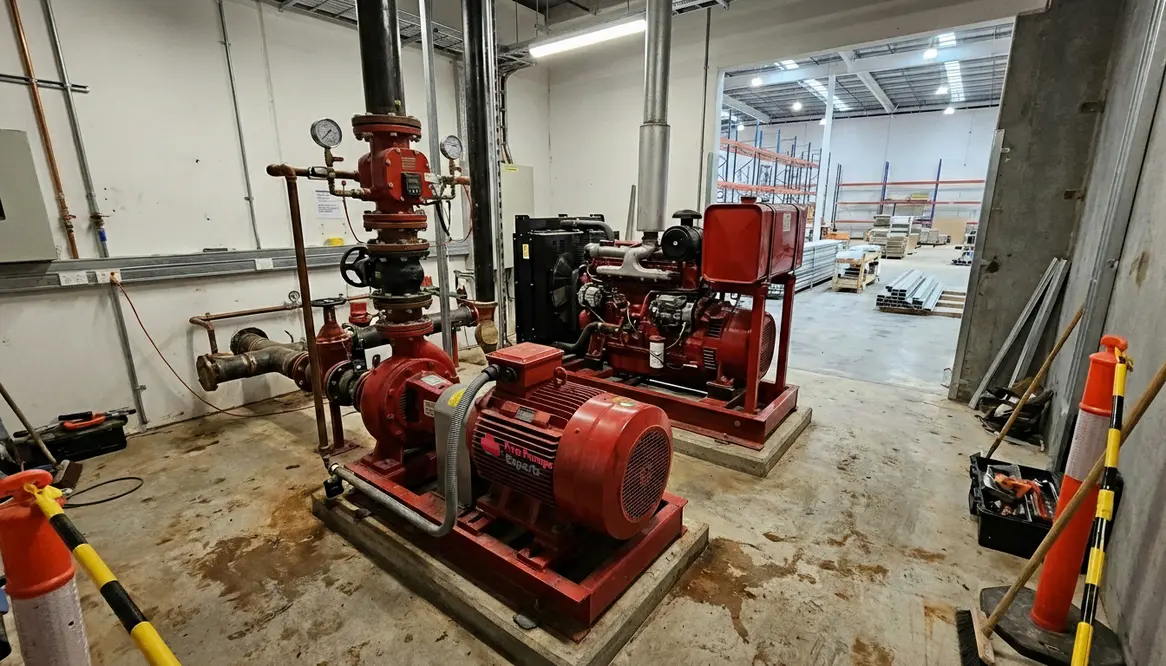
Fire Pump Retail Adelaide Guide for Large Builds
I have spent enough time around large retail builds to know one thing for certain. Fire protection is not where you improvise. When it comes to fire pump retail Adelaide projects, the right system is not just a code requirement. It is the quiet guardian that stands ready when everything else fails. And while it may not get the spotlight like a grand opening sale, it is far more important than a half price sneaker drop on a Saturday morning.
So let me walk you through how I approach fire pump selection for major retail developments. Slowly, clearly, and with just enough personality to keep you awake.
What matters most when selecting a fire pump for large retail buildings?
I start with one principle. The pump must match the risk, not just the building size. Large retail spaces in Adelaide often combine wide floor plates, storage zones, and high customer traffic. Therefore, the fire load is not uniform.
First, I look at hazard classification. A fashion outlet behaves very differently from a warehouse style retailer stacked to the ceiling. Then, I evaluate water supply reliability. Adelaide has solid infrastructure, however, relying solely on town mains is like trusting WiFi during a storm. You might get lucky. Or you might not.
Next, I calculate flow and pressure requirements. These are not guesses. They are derived from sprinkler layouts, hydrant demands, and system redundancy. Moreover, I ensure compliance with Australian Standards, particularly AS 2941.
Because at the end of the day, the pump does not care about budgets or deadlines. It either performs or it does not.
Understanding system types for fire pump retail Adelaide projects
Now, let us talk systems. Not all pumps are created equal, and choosing the wrong type is like casting the wrong actor in a blockbuster. It might look fine at first, but eventually, everyone notices.
Electric Fire Pumps
Reliable and efficient when power supply is stable. Ideal for developments with strong infrastructure.
Diesel Fire Pumps
Self sufficient and dependable during power outages. These are often my go to for redundancy.
Jockey Pumps
Maintain system pressure and prevent unnecessary starts. Think of them as the system’s quiet caretaker.
Packaged Pump Sets
Pre assembled units that reduce installation complexity. Useful when timelines are tight.
In many retail fire protection systems in Adelaide, I recommend a combination. Redundancy is not a luxury here. It is a necessity.
How do I align pump selection with compliance and performance?
I treat compliance as the foundation, not the finish line. Australian Standards set the baseline, however, real world performance demands more.
So I coordinate closely with hydraulic engineers, fire consultants, and certifiers. Together, we confirm that the pump curve aligns with system demand across all operating points. Additionally, I ensure the controller logic supports automatic operation without hesitation.
Then there is testing. I insist on full performance testing before handover. Because reading specs is one thing. Watching a system deliver under pressure is another entirely.
And yes, I have seen systems fail during testing. It is not dramatic like an action movie, but it is just as revealing.
Planning for future expansion and operational reliability
Retail developments evolve. Tenants change, layouts shift, and storage densities creep upward over time. Therefore, I always design with the future in mind.
I allow for additional capacity where practical. I also consider space for upgrades, whether that means larger pumps or additional units. Because ripping out a pump room later is about as enjoyable as remodeling a kitchen during dinner service.
Moreover, I think about maintenance. Easy access, clear layouts, and reliable components make a huge difference over the system’s life. A fire pump that cannot be serviced easily is a liability waiting quietly in the corner.
Common pitfalls I avoid in large scale retail fire systems
I have seen enough projects to recognize patterns. Some mistakes show up again and again.
Underestimating demand often leads to undersized pumps. This is not a small issue. It is a critical failure.
Ignoring redundancy creates a single point of failure. In large commercial environments, that is unacceptable.
Poor coordination between disciplines results in mismatched systems. The pump, the pipework, and the controls must work as one.
Overlooking lifecycle costs can lead to cheaper upfront choices that cost far more over time. A pump that fails early is not a bargain.
So I stay vigilant. Because in this field, details are everything.
Fire pump retail Adelaide strategy that actually works
When I approach a fire pump retail Adelaide project, I blend engineering precision with practical foresight. I do not chase trends or shortcuts. Instead, I focus on systems that deliver consistent performance under real conditions.
I prioritize reliability, compliance, and adaptability. I also communicate clearly with stakeholders, ensuring that everyone understands not just what we are installing, but why it matters.
And yes, I occasionally remind teams that this is the one system we hope never gets used. Yet if it does, it must work flawlessly. No excuses.
FAQs
Ready to get it right the first time
If you are planning a large retail development, do not leave fire protection to chance. I can help you design and implement a system that performs when it matters most. From initial planning to final commissioning, every step counts. Reach out today, and let us build something that stands strong, even in the face of the unexpected. Because peace of mind is not optional. It is essential.