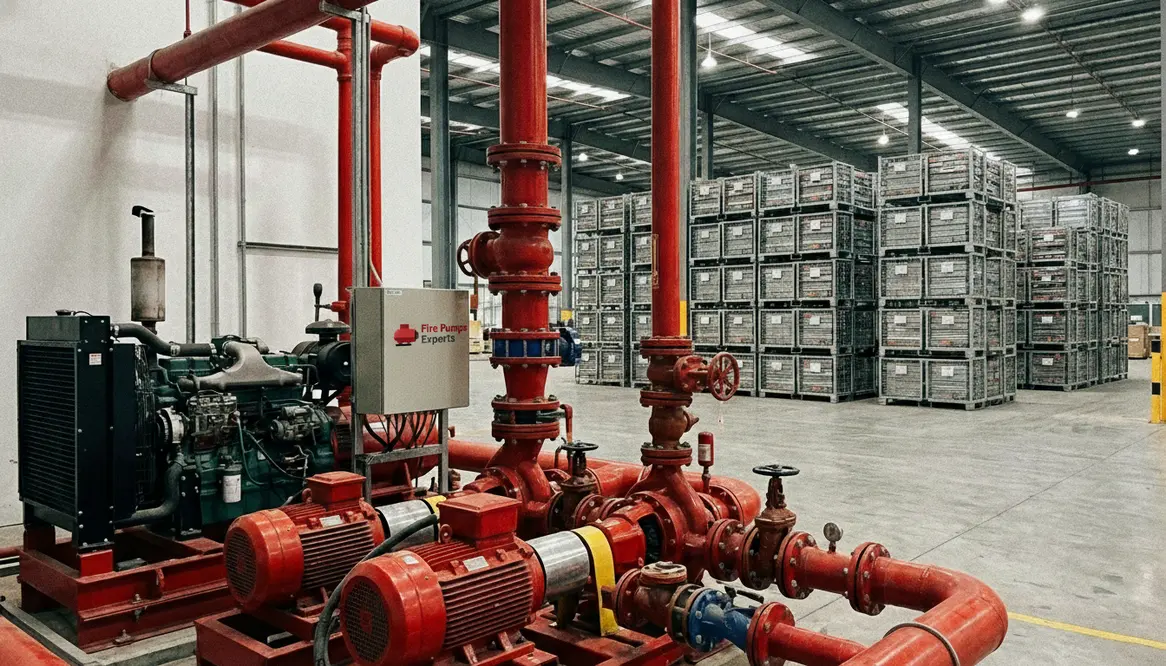
Fire Pumps for EV Battery Warehouse Risk Management
I have spent years walking through large industrial buildings where risk hums quietly in the background, waiting for the right moment to speak up. In EV battery warehouses, that risk does not whisper. It lingers. It builds. And without the right systems in place, it can turn a routine day into a headline. That is why Fire risk management for stored battery systems is not just a checkbox. It is a strategy, a mindset, and frankly, a necessity. Today, I want to walk you through how fire pump requirements play a critical role in keeping these facilities safe and operational.
These facilities are not just more of the same industrial storage. They are concentrated energy hubs where design choices about pumps, water supply, and redundancy quietly determine whether a fire is a contained event or a catastrophic failure. Treating Fire risk management for stored battery systems as an afterthought is a fast track to learning some very expensive lessons.
What makes EV battery warehouses uniquely challenging?
Let me answer this plainly. EV batteries carry high energy density. That means when something goes wrong, it goes wrong with enthusiasm. Thermal runaway is not just a buzzword. It is a chain reaction that can escalate faster than your morning coffee cools down.
Because of this, traditional fire protection approaches often fall short. However, when I evaluate these facilities, I look for systems that can respond quickly and sustain water delivery under extreme conditions. Fire pumps are not optional here. They are the backbone of any serious protection plan.
Moreover, battery storage layouts often involve tight spacing and vertical stacking. That setup increases heat retention and limits natural suppression. So, the fire pump must support systems designed for both reach and endurance.
Add in charging operations, electrical infrastructure, and the occasional creative forklift maneuver, and you have a setting where Fire risk management for stored battery systems has to be intentional, layered, and relentlessly practical.
Fire pump sizing and water demand in high density battery storage
Hazard classification and water demand
Now let us talk numbers, because feelings do not put out fires. I always start with hazard classification. EV battery warehouses typically fall into high hazard industrial categories. As a result, water demand is significantly higher than standard storage facilities.
Fire pumps must be sized to handle peak flow rates required by sprinkler systems, hose streams, and any supplemental suppression systems. In many cases, I recommend designing for extended operation periods. Why? Because battery fires do not politely extinguish themselves after a few minutes.
Redundancy and reliability under pressure
Additionally, redundancy matters. I have seen facilities rely on a single pump, and let me tell you, that is like bringing one umbrella to a hurricane. Dual pump configurations, often diesel backed, provide reliability when power systems fail.
Key design considerations
- High flow capacity to match suppression demand
- Extended run time capability
- Backup power integration
- Compatibility with specialized sprinkler systems
Common pitfalls I see
- Undersized pumps for high hazard loads
- Ignoring pressure losses in large facilities
- Lack of routine testing plans
- No redundancy in critical systems
How do fire pumps support Fire risk management for stored battery systems?
From standalone equipment to integrated strategy
This is where everything connects. Fire pumps are not standalone heroes. They support a larger ecosystem of protection. When I design or assess systems, I ensure the pump integrates seamlessly with detection, suppression, and containment strategies.
For example, early detection systems can trigger suppression quickly. However, without adequate pump pressure and flow, that response loses effectiveness. Therefore, the pump ensures that every sprinkler head, every hose line, and every suppression zone performs as intended.
Zoning, orchestration, and real-world performance
Also, I consider system zoning. Large warehouses benefit from sectional control, allowing targeted suppression without compromising the entire facility. Fire pumps must maintain consistent performance across these zones, even during simultaneous activation.
Think of it like an orchestra. The detection system may be the conductor, but the fire pump is the rhythm section. Without it, everything falls apart, and not in a dramatic movie way, more like a very expensive insurance claim. That is why Fire risk management for stored battery systems always comes back to how well the pump can support the rest of the ensemble under stress.
Compliance standards and real world application
Beyond the minimums of codes and standards
Codes and standards are not suggestions. They are the baseline. I regularly work with NFPA guidelines, especially those addressing energy storage systems and fire pump installations. However, compliance alone does not guarantee safety.
In practice, I often go beyond minimum requirements. For instance, I account for future expansion. EV battery demand is growing, and facilities rarely stay the same size for long. Designing a fire pump system with scalability in mind saves both time and cost later.
Testing, maintenance, and operational readiness
Furthermore, I emphasize testing and maintenance. A fire pump that has not been tested is like a gym membership you never use. It looks good on paper, but it will not help when you need it.
Documented procedures, trained staff, and clear responsibilities all sit firmly under the banner of Fire risk management for stored battery systems. The best hardware in the world does not compensate for a crew that is surprised by their own equipment during an emergency.
Integrating suppression strategies with pump performance
Blended suppression approaches
Suppression in EV battery warehouses is evolving. Water based systems remain essential, but they often work alongside specialized methods like foam or clean agents in certain zones. I ensure the fire pump can support these combined approaches.
Flow consistency is critical. Sudden drops in pressure can reduce suppression effectiveness, especially in high heat scenarios. Therefore, I prioritize systems that maintain stable output even under fluctuating demand.
Environment, housing, and human behavior
Additionally, I consider environmental factors. Large facilities may experience temperature variations that affect equipment performance. Proper housing and climate control for fire pumps can prevent unexpected failures.
And yes, I have seen a pump room treated like a storage closet. That is never a good sign. If your fire pump shares space with holiday decorations, we need to have a serious conversation. Housekeeping is not glamorous, but it is very much part of Fire risk management for stored battery systems.
Conclusion: Building resilience through smarter fire pump design
When I look at EV battery warehouses, I see both opportunity and responsibility. The right fire pump system does more than meet code. It protects assets, supports operations, and ensures long term resilience. If you are managing a commercial or industrial facility, now is the time to evaluate your systems. Work with experts who understand the risks and can design solutions that hold up under pressure. Because in this line of work, preparation is everything.
If you are starting from scratch, upgrading, or simply not sure where your current installation stands, a focused review of Fire risk management for stored battery systems and pump performance is one of the highest value actions you can take. It is far better to ask tough questions during design than to watch those gaps play out during an incident.
For deeper technical resources, case studies, and guidance on high hazard pump configurations, you can explore industry material available at https://firepumps.org, then sit down with your engineering team and apply it to your specific facility. The combination of solid reference material and site-specific thinking is where real resilience is built.