Qatar Fire Pump Requirements for Commercial Projects
Qatar Fire Pump Requirements for Commercial Projects: What I Check Before a Build Moves Forward
When I review a Qatar commercial project, I always start with one simple truth: the fire pump is not a box to tick. It is the heartbeat of the fire protection system. If it fails, the whole building can look very fancy right up until trouble arrives, and then nobody wants to be the person saying, “We should have checked that earlier.” In large offices, towers, malls, hotels, warehouses, and industrial sites, I treat fire pump planning as a core design issue, not an afterthought. So, before concrete sets and deadlines start acting like villains in a bad action film, I make sure the pump system matches local rules, building demand, and real life pressure needs.
Understand the Qatar commercial fire pump rule set
For a commercial project in Qatar, I first look at the code path that shapes the fire pump choice. In most cases, the system must support the sprinkler network, hose reel demand, standpipe demand, and any special risk area tied to the site use. Because every major property has different fire loads, I never assume one pump size fits all. Instead, I check the occupancy type, building height, floor area, water source, and the required pressure at the highest point of use.
Also, I keep an eye on local civil defense expectations, because approval depends on more than drawings that look neat in a meeting. The system must prove it can deliver the right flow and pressure during a fire event. That means proper pump sizing, correct suction conditions, reliable power supply, and tested components. In other words, the pump cannot just sound impressive in a brochure. It must perform under stress, which is where the real drama begins.
What I check in fire pump sizing
When I size a pump for a Qatar commercial site, I focus on demand first. I calculate the water flow needed for the sprinkler system, then I add the demand from hose reels or standpipes where required. After that, I confirm the pressure loss through pipes, valves, fittings, and elevation. This gives me the true pump duty point.
Then I compare that duty point with the site water supply. If the municipal supply is weak or unstable, I plan for a tank and pump arrangement that can still deliver the required fire protection. I also make sure the pump does not operate too far left or right of its best efficiency point. A pump that works too hard ages fast, and like a tired actor on a long press tour, it starts making bad choices.
Key fire pump components I verify
System part
Main fire pump
Jockey pump
Diesel backup pump
Fire water tank
Controllers
Suction and discharge lines
What I verify
Required flow, pressure, and power source
Small pressure loss control and steady system pressure
Emergency operation if electric supply fails
Enough reserve for the design fire duration
Automatic start, alarms, and fault monitoring
Correct pipe size, valves, and low loss flow
How I handle pump room design and installation
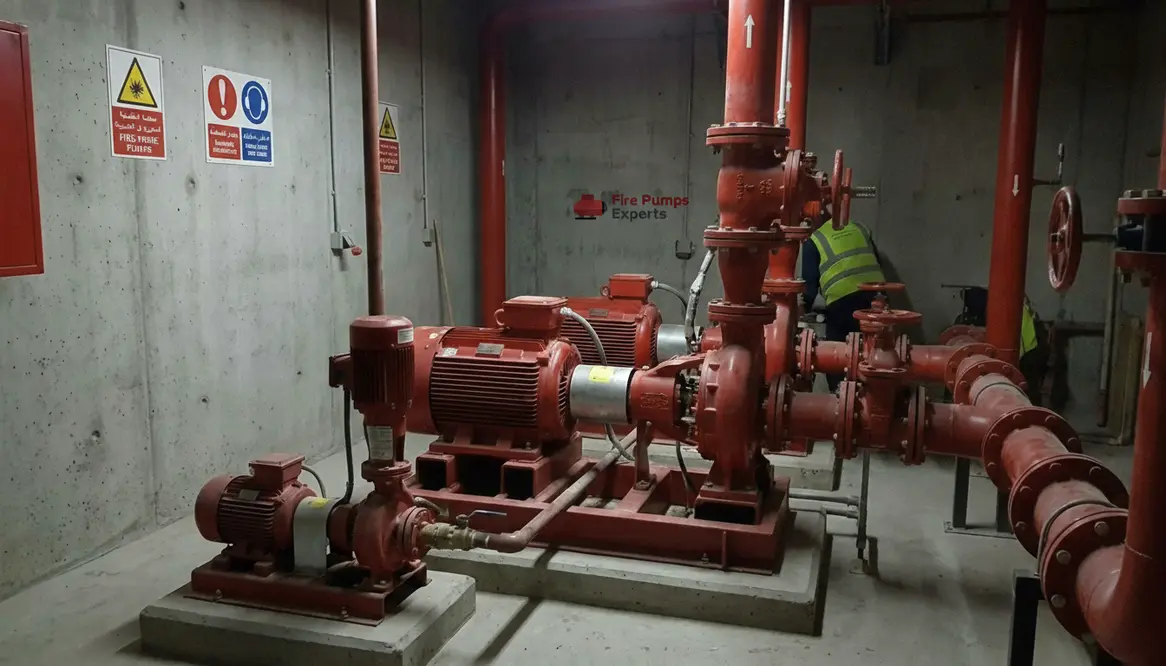
I never treat the pump room like a storage closet with a badge. It needs space, access, ventilation, drainage, lighting, and safe maintenance clearance. If a technician cannot reach the pump, test the controller, or inspect the valves without climbing over pipes like a side quest in a video game, the design needs work.
For a commercial building, I also check vibration control and sound levels. Large pumps can shake a room and annoy the whole building, which is great if the goal is a horror movie, but not great for business. So, I support the pump base properly and keep the installation clean, direct, and service friendly. Clear labeling also matters. In an emergency, nobody wants to play “guess the valve.”
Why testing and approval matter in Qatar
Testing is where theory meets reality. I ask for flow testing, pressure testing, controller checks, diesel start tests, and alarm confirmation before handover. In a commercial project, I want evidence that the system can reach the required point under actual conditions. I also want records that show the installation matches the approved design.
Approval becomes smoother when the project team documents pump curves, tank capacity, power backup, and as built details clearly. If a consultant or authority reviewer sees a gap, delays can pile up fast. And as everyone in construction knows, delays do not arrive politely. They usually show up with paperwork.
Practical checkpoints for a Qatar commercial fire pump design
Match real building demand
Commercial towers, malls, hotels, and warehouses rarely behave like neat textbook examples. Retail anchors push higher fire loads, hotel back-of-house areas can be dense with services, and industrial tenants bring their own risk profile. I start by checking whether the fire pump demand is built around the actual occupancy and fire scenarios, not just default values.
Confirm water source strategy
Some sites rely on municipal mains, some on storage tanks, and some on a blend of both. For many Qatar commercial projects with high-rise or mixed-use layouts, I lean toward dedicated fire tanks to reduce the risk of low pressure during peak city demand. I check that suction conditions, tank elevation, and pipe routing support the pump’s required net positive suction head so the pump does not end up cavitating when it is needed most.
Power reliability and redundancy
Fire pumps in serious commercial facilities cannot rely on wishful thinking about power stability. I verify that electric supplies are backed up where required and that the diesel pump is sized, vented, and fueled correctly. Nothing ruins a carefully calculated design like a backup pump that has plenty of horsepower on paper and a nearly empty fuel tank in reality.
Field coordination and Qatar commercial approvals
Site realities vs drawings
Floor plans rarely survive first contact with real site constraints. Structural beams appear where clear pipes were once drawn, and tenants ask for new shafts halfway through construction. I review whether the pump room location, suction routing, and discharge risers still align with the fire strategy after all these shifts. If not, it is better to adjust early than argue about “as built” compromises later.
Documentation that keeps reviewers calm
For smooth civil defense review, I want a clear package: pump data sheets, curves at the selected duty point, electrical single-line diagrams, tank sizing calculations, pump room layout, and test procedures. When this is presented cleanly, the approval process for a Qatar commercial building is far more predictable and far less dramatic.
FAQ: Qatar fire pump requirements for commercial projects
Final thoughts and next step
If I want a commercial project in Qatar to pass approval and perform when it matters, I treat the fire pump system as a serious design decision from day one. I verify the demand, check the room, confirm the backup, and test the whole setup with care. Every Qatar commercial facility that takes this approach ends up with a pump system that feels less like a mysterious machine and more like a trusted part of the building’s safety backbone.
So, if your next project needs a reliable fire pump solution for a commercial or industrial facility, now is the time to plan it properly, document it well, and get the system right before anyone starts pretending “it will probably be fine.” A clear strategy, a tested installation, and a well-managed pump room cost far less than the chaos of last-minute redesigns, failed inspections, or a system that hesitates when it is finally called to work.