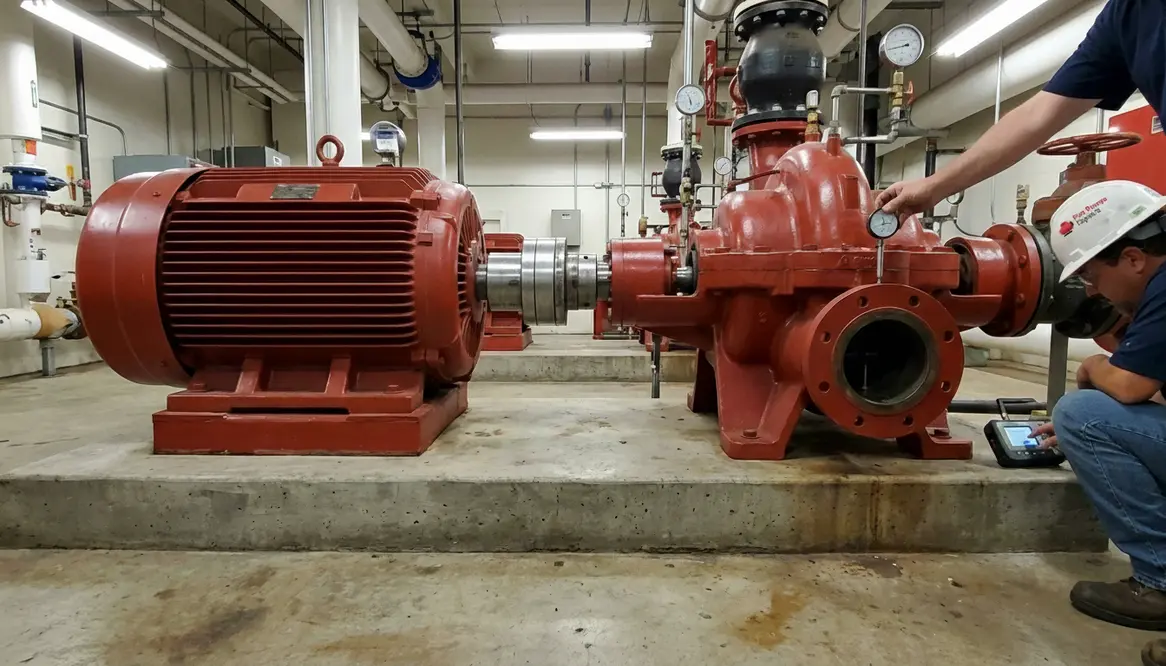
Split Case Fire Pump Alignment Irvine Guide
I have spent enough time around mechanical rooms in Irvine to know one truth. When a system fails, it rarely whispers. It roars. And when we talk about split case fire pump alignment Irvine, we are talking about a quiet detail that decides whether your fire protection system performs like a hero or folds like a lawn chair at a summer barbecue. In large commercial and industrial buildings, alignment is not just a technical step. It is the backbone of reliability.
So let’s walk through it together. Slowly. Clearly. With just enough humor to keep us awake.
Why alignment matters more than most people realize
At first glance, alignment feels like a small task. A few adjustments. A couple of measurements. Done, right? Not quite.
When a horizontal split case fire pump is even slightly misaligned, the consequences stack up fast. Bearings wear down. Couplings strain. Energy use creeps higher. And eventually, the system you rely on during an emergency decides it would rather sit this one out.
Moreover, in high demand environments like hospitals, data centers, and large commercial campuses, failure is not an option. I have seen facilities invest millions in infrastructure, only to overlook alignment during installation or maintenance. That is like buying a luxury car and never checking the tires.
Proper alignment ensures smooth power transfer from motor to pump. As a result, vibration drops, efficiency improves, and the lifespan of your equipment stretches out like a good Sunday afternoon.
Common causes of alignment problems in Irvine facilities
Irvine brings its own personality to the table. Between temperature shifts, operational demands, and building scale, alignment issues tend to follow familiar patterns.
Here are the usual suspects I encounter:
• Thermal expansion
As systems heat up during operation, metal components expand. If alignment was set cold without accounting for this, things drift.
• Improper installation
Even a small shortcut during setup can lead to long term misalignment. And yes, I have seen it more times than I care to admit.
• Foundation settling
Large buildings shift subtly over time. That movement translates directly into your pump alignment.
• Pipe strain
When piping pushes or pulls on the pump casing, alignment suffers. Think of it as someone constantly nudging your elbow while you are trying to write.
Because of these factors, split case fire pump alignment Irvine requires both precision and ongoing attention, not a one time checkmark.
How I approach precise alignment in horizontal split case units
When I step into a facility, I do not guess. I measure. Then I measure again, because confidence without data is just optimism in a hard hat.
What I focus on
• Angular alignment between shafts
• Parallel alignment across coupling faces
• Soft foot conditions at the base
• Pipe stress impact on the pump casing
Tools I rely on
• Laser alignment systems for precision
• Dial indicators for verification
• Feeler gauges for base corrections
• Vibration analysis for performance checks
Additionally, I always account for operating temperature. Cold alignment numbers rarely tell the full story. So I adjust targets to match real world conditions. That is where experience comes in, and where guesswork exits the building.
And yes, there is a certain satisfaction when everything lines up perfectly. It is like tuning a guitar and finally hitting that clean chord. Even if no one else hears it, you know.
Can misalignment really cause system failure?
Short answer? Absolutely.
Longer answer? Misalignment creates vibration. Vibration creates wear. Wear creates heat. And heat, as we all know, is rarely a friend in mechanical systems.
In fire pump systems, this chain reaction can lead to seal failure, coupling damage, or even shaft breakage. And when that happens during a critical moment, the consequences go far beyond repair costs.
Furthermore, regulatory compliance comes into play. Fire protection systems in commercial and industrial facilities must meet strict performance standards. Misalignment can quietly push your system out of compliance without any obvious warning signs.
So while alignment might not be the most glamorous topic, it is one of the most important. Think of it as the backstage crew in a big production. If they mess up, the whole show collapses.
Maintaining long term performance without constant headaches
Now here is the part I like. Prevention.
Once alignment is properly set, maintaining it becomes a matter of discipline. Not guesswork. Not luck.
I recommend routine checks tied to operational hours and seasonal changes. Additionally, vibration monitoring gives early signals before issues grow teeth. And when adjustments are needed, small corrections go a long way.
It is also important to train on site teams to recognize early warning signs. Unusual noise. Slight increases in vibration. Temperature shifts. These are not random quirks. They are clues.
Because in my experience, the best fire pump systems are the ones that never surprise you.
Split Case Fire Pump Alignment Irvine: Quick Reference Answers
If you are managing a facility where reliability is non negotiable, keeping an eye on split case fire pump alignment Irvine details pays off every time. The questions below cover the basics most teams ask when they start taking alignment seriously.
Conclusion
If you are responsible for a commercial or industrial facility in Irvine, alignment is not something to leave to chance. I take a precise, measured approach to ensure your fire pump system performs when it matters most. Reach out today and let’s make sure your system runs smoothly, efficiently, and without surprises. Because when the moment comes, your equipment should respond like a seasoned professional, not a confused extra in the background.
If you need deeper technical references, you can always review the guidance at https://firepumps.org, then tailor those best practices to your specific split case fire pump alignment Irvine conditions and facility layout.